Showing posts with label transphobia. Show all posts

Sunday, October 11, 2015

Kindred

In February 2015, a League of Legends tournament operator changed a rule for their girls-only Iron Solari tournament: only one LGBT girl per team, or there would be an “unfair advantage.” Riot, the makers of League of Legends, had an immediate response.

When it comes to LGBT acceptance, Riot has been doing two things that have compelled me to write this, and write it now, and that is why I am not getting much else done today; because I just cannot stop thinking about all the ways in which this is coming together, and the ways in which Riot has been really really really clever. They are taking an audience that has a not-insignificant amount of bigots, and subtly causing them to shift and open their minds in ways that they might not necessarily feel comfortable doing directly with humans.

I don't remember when I started playing League, exactly, but it was definitely quite a while before I had my whole gender revelation. I would sometimes kind of take the game to task, among my friends, for some things that I saw as sort of like playing to tropes, playing to ethnic stereotypes, or playing to even gendered stereotypes. But Riot is not really any more guilty of that than most other media producers I've seen who are inventing original characters and original stories and original content around their game, or even just broadly, like comics or movies or whatever.

By that I mean things like the women being always thin, very fit, and the same with the guys for the most part, with a few exceptions. My earlier complaints would be things like, on the male side, with male champions, you have champions like Gragas, you have champions like Urgot, who are male, and definitely clearly masculine, but also in a kind of non-mainstream way, in that Gragas is very heavy, and Urgot is kind of grotesquely disfigured, and sort of half-human. There weren't really any female examples of that.

The women were all still really thin. There was some variance in breast size, and that was kind of it. But that was the starting point for something that's become really impressive. Waifish Jinx came out, and she had very very very small breasts. She was the first female champ that I remember seeing who wasn't a child, like Annie, with such a small build. It was nice to see some variety come in.

But in the last six months or year, Riot has really started to get creative with their champions. They are challenging their community's capacity to understand things outside of gender binary, and outside of culturally normalized gender roles. They are doing this by presenting new champions who don't look like what the audience thinks someone who uses pronouns like "she" and "her" should look like, but instead just presenting someone who is that way, in a world where that mostly doesn't matter. They have the ability to do this because it's a fantasy setting. They can come to their audience with a character that is not human at all, where all of the extranormative things about that character are so out there that their gender becomes the least confusing thing about them.

The first example of this, which was kind of impressive, but didn't blow me away as much as the one I'm going to get to, is Rek'sai. Rek'sai is female, an alien monstrosity... uh, thing. She's this rapidly-tunneling land-shark sort of creature that's kind of short and squat and really wide, but she also will literally pop up out of the ground under your champion, and take them to pieces.

On the forums, there'd be some discussion, where people would say things like "I wonder when he will come out?" or whatever, but when Rioters would speak about her, they'd gender her correctly because that's a matter of brand consistency, if nothing else. Riot is clear about what Rek'sai is. There is no ambiguity about her gender, but a fair sized segment of people see a character concept like Rek'sai, and they want the gender to be masculine because of how she looks. Even so, whenever she was misgendered on the forums, there was always a response from someone in the community correcting that.

So we have people getting used to this model of understanding two things. One is that if someone misgenders someone else, it's appropriate to correct them, and two, any idea of what is required for someone or something to be female is challenged. For non-humans, we don't get hung up on this as much in reality. You see a girl dog, and you think it's a boy, and you say "how old is he," and they say, "oh, she's two," and you say, "oh, 'she,'" okay, great. No big deal. Minor mistake, it's fixed, nobody cares, and the dog never had any idea.

But in fantasy settings, we have the advantage of creating something entirely new that's outside of everyone's understanding or experience, and saying, by the way, this thing has gender, and even though your expectation based on appearance is that her gender is male, it's not; her gender is female. And that maps really pretty closely to the thought processes that are required to get your head around trans people being legitimately whatever gender they understand themselves to be.

One of the difficult things in educating people about what being trans looks like is managing any expectation that people think about these things if they don't know any trans people, or anyone else that is really outside of the realm of their experience, outside the realm of their day-to-day lives. If they don't have a reason to know about it, if they feel they don't have a reason to have the vocabulary about it, it can feel kind of oppressive to have someone come in and say, "you need to behave this way, you need to refer to me in that way." Rek'sai gives Riot a way to get people to do that without feeling so opposed to it, because League of Legends is something that they've come to of their own accord.

People are showing up and playing because they love the game. Whether they love the mechanics or the lore or the construction of the world, the way that the maps are designed, whatever it is, they want to be there. They're invested in it. And Riot, the people who have created that world, are able to dictate some parameters of that world, and say, "this is it, this is the world, so, take it or leave it." And they have enough of a customer base, they have a good enough product in terms of a value proposition in gaming, that they can get away with that.

The thing that really impressed me, though, was not Rek'sai. I didn't even realize all of these subtle things about Rek'sai until recently. The thing that's impressed me a lot more is this teaser of a champion that's not out yet, as of this writing, called Kindred. Kindred, if you look at the concept art, is designed as two spirits. Which itself un-subtley refers to a widely understood queer and/or transgender model; the Native American two-spirit.

Kindred is plural, a pair of beings who are never without each other, who cannot be separated further. They are two, but they are atomic. They are two, but they are one. And in the cinematic teaser, Wolf has a voice that might be described as male-typical, and Lamb has a voice that might be described as female-typical. And they also have sort of more stereotypically masculine and feminine sort of properties. Wolf, as one might guess, is the more masculine energy side, more aggressive, feral, direct action, attacking stuff. And Lamb is more overseeing, caretaking, with a healing aspect that is represented in "Lamb's Respite," Kindred's ultimate ability. But because they are two, even though it's a singular entity in terms of game mechanics, the pronouns for this champion are "they" and "them" and "theirs." And so, I've seen already on the boards, people will pronoun Kindred as "he" or "she," and sometimes they are corrected. And when corrected, sometimes there is a pushback. But in this case, there's no ambiguity about the character's pronouns the way there may be some understandable debate about them in reality, because Riot controls the reality of Runeterra, the game's setting, absolutely.

Riot doesn't need to police the forums and go in and correct people misgendering Kindred via pronouns, they can just keep using those pronouns consistently in all media regarding the character. In this way, they also set a great example for trans people in managing reaction to being misgendered in their own lives; if you are misgendered and you correct someone, there's a chance you'll have some pushback, and it may even become relatively violent. But, if you just keep asserting yourself, people will probably come around eventually, and even if they don't, your allies will reveal themselves. The other thing that's really obvious as a call-out to this sort of two-spirit model, which is really heavily influenced by gender, is the symbology that's used for the masks that Lamb and Wolf wear, and even their own coloring, which are both plainly inspired by the yin and yang concept. With the darker shade of coat and the lighter tint of mask, Wolf is plainly masculine with an aspect of feminine, in terms of visual composition, and is established in opposing balance with Lamb, whose colors are reversed.

This is really impressive to me, that a company that has this size of an audience, an audience that has a lot of people in it who are really transphobic, biphobic, take your pick... non-cisgender-heterosexual-phobic... has been releasing champions that challenge our notions of gender. I saw something on the boards the other day, where this trans girl was being bullied about her appearance and the fact of her being trans. I reached out to her and was like, "hey, I'm here for you." It was important to me to be sure that she knew she was not alone, because being rejected so broadly leads very quickly to a sense of alienation, a sense of isolation, a sense that maybe who we are is wrong, when nothing could be further from the truth.

She seemed confused by this, and a little bit defensive, which is understandable given the kinds of introductory messages girls like us get online. I went on to say, more or less, "this is me, here's my Facebook page if you want to get to know me at all, but I'm mostly just here to let you know that I'm here for you, and that's it." And I left her alone after that, but she's initiated chat with me since then, and I feel like I've done a good thing. I reached out to her in the first place because her forum name and summoner game name is very much "I am female," and her post on a selfies thread on the general discussion board had people saying things like, "that's not a trap, that's an ambush," which is referring to this idea that a trans girl is trying to "trap" someone, or trick them into thinking that they're a "real girl," as if they were anything else.

Somebody else posted this sort of trollface or grossed-out kind of face cartoon drawing, that said "cross-dresser" under it really large. There's definitely a lot of vitriol around girls like me in gaming communities in general, and specifically within League's community. But Riot, for its part, is saying that they don't agree with that. They're not just passively saying "hey, we don't like that," but that they're completely opposed to it in their corporate philosophy.

This was really illustrated clearly in February, when a tournament operator called Garena, from the Philippines, was changing some rules around their Iron Solari tournament. The Solari in game lore are represented in Leona, who has sun-themed abilities and iconography. So the Iron Solari tournament, inspired by that, is a girls-only League of Legends tournament.

Very briefly, as in "in the course of 24 hours" briefly, in February, Garena issued a statement saying that they had heard from a number of their players that perhaps if a team had a lesbian or bi or transgender girl on their team, that they got an unfair advantage for some unknown reason. The text of the announcement literally said "may probably have some unfair advantage." They of course got a backlash from people in the community, but then they had a pretty strong and unsubtle backlash from Riot themselves.

Riot tweeted an unambiguous statement that "LGBT players are welcome at official LoL tourneys. We're working with partners to ensure consistency with our values across all regions." In other words, if you do not allow unrestricted access to LGBT players at your tournament, it will not be an official League of Legends tournament. And if you don't have the support of League of Legends' publisher for your League of Legends tournament, that is a big problem.

The next day, Garena rescinded the rule, saying they "sincerely apologize for any offense we caused to the LGBT and gaming communities." It had the usual corporate non-apology trappings of how their initial decision "created a lot of good discussion and debate," and how they had been "discussing the ruling with our partners and re-examining our approach" and ultimately changed their minds, but it was pretty clear what happened.

Maybe, I don't know, six months after Kindred's come out, it will be really natural for people to refer to someone that they understand as a single entity as "they" or "them." So when they meet a non-binary person after that, now they have a model. Instead of having a reaction of "that's crazy, that doesn't make any sense," they have this concept they can attach it to. It might not be completely accurate or relevant, but it will be in the ballpark. Someone can say to them, "hi, my name's Chris, my pronouns are they, them, and theirs," and instead of having no idea how to respond, now the listener can think, "oh, they're like Kindred, okay."

And then everything is easy. Because they've already had conversations with their friends about Kindred, as a champion, and because Riot is very clear about "this is the grammar," and "these are the words," it gives people a way, through play, to flip that switch, and get their heads around saying something like, "we need Kindred to come and gank top, we need them to get there fast." And then they meet someone who's non-binary, and suddenly it's not that hard for them to talk to their friends about this person, or to use their pronouns properly. If their friends play League, too, there's no need to go into an explanation that they may not feel equipped to give. It just becomes normal, or at least more normal, and less alien.

They can say, "I was hanging out with Chris last night at their place, we had pizza, and they were like, 'do you want Mountain Dew, or Coke?' and I was like, 'I want vodka,'" or whatever. The pronouns disappear, mechanically, and the message is conveyed because the hangup of using a pronoun that deliberately keeps some aspect ambiguous, or defined as "outside of the Gender Binary," disappears, too. It normalizes the use of non-binary pronouns, which is fantastic. Non-binary pronouns are something that I still struggle with. Like most people, I have been encultured to presume gender and assign it mentally, even to people I will never interact with at all.

If I see someone on a bus that appears outwardly feminine to me, and I tell a story about them later to a friend, I will almost certainly refer to them as "she," even though that may not be accurate. I have non-binary friends whom I still instinctively read as male or female, and having an extra model in my head to associate them with reduces that.

I know very few non-binary people, and it's difficult for me to correctly use their pronouns. It is sort of alien to me. And I also understand that they're right, and that the problem is me, and not their identity.

This is the genius of what Riot is doing with these kinds of champions, like Rek'sai, and Kindred. They're saying, "Rek'sai is she. Kindred is they." And that's it. They don't have to come out and have Rek'sai say "my pronouns are she/her/hers," they just always consistently state them that way. Because that's what they are.

Wednesday, September 2, 2015

Hero of the Sin'dorei

I did mention elsewhere that I'd probably blog about my return to WoW before I'd blog more about my sexuality or whatever, and now that time has come. But fear not, if you're here for a progressive social justice examination of the world, broadly, and, indirectly, of the World (of Warcraft), you'll find what you're after. You'll just have to wade through a bunch of self-involved nerdy garbage to get to it, and, since you're on the internet, that should be old hat by now.

I first started playing WoW probably around 2008, and although I enjoyed the game quite a lot, especially in terms of mechanics, I ended up having a falling-out with Blizzard. I was always a role-player in these games, living out the lives of women I wished I was because I didn't yet understand that I already was a woman, and could go start living my own actual life any time.

I was on a role-playing server, which means the players are generally expected to play and act, via their characters, as though they are actually IN the World of Warcraft. This extends to "proper" names for the culture of whatever race the player has selected for that character. If you have a character on an RP server named CaptainNutStomper, you will probably be reported and have that character forcibly renamed, at least. But, WoW also has several Non-Player Characters (NPCs) who have names that clearly and unsubtley reference real-world figures, such as Haris Pilton, a fashionable bag vendor. So I made a Night Elf who was a Druid by class, and since Druids can assume the form of a cat, I named her Lolcat.


I'd developed an entire backstory that I wrote out to very logically explain why she had this name in a world without an internet or cat memes. It was essentially a phonemic evolution of a slightly different phrase, and, given the game's use of real-world figures and concepts as gags within the World, I thought this would be well-received, or at the very worst met with an eye-roll and a groan. But someone reported the name as not lore-appropriate, and I got into a back-and-forth with Blizzard's customer service about it. It ended with them saying "sorry, no" over and over, and me saying "I will no longer support your company in any way," before selling or throwing out every Blizzard product I'd collected to that point, which was a fair pile of games and merchandise.

This may seem childish and petty and overreactive, and if you were to say so, while past-me would have gotten even more upset, present-me is right there with you. I'm actually laughing about it, as I write this. Laughing at myself. I still think Blizzard was hypocritical, but I also think that doesn't matter. I wanted to control their behavior, but really, I can only ever control my own, and I behaved poorly. The actual relevant thing here is that this was my mode of interacting with the world for a very long time. I interacted with the world as a child who had had his toys taken away, even when I hadn't. Even when I still had more than I could hold or keep track of.

I was very angry and frustrated with life in general, and I had no idea why. Everything felt wrong, but I could not articulate how or in what way, along what axes. I was, I assumed, a straight white male, and I was bombarded with media messaging about how I was a privileged person, how I had all the power in any social interaction, and yet that felt wrong to me. When the dot-com bubble burst, I was unemployed for a few years. That ended when I enlisted in the Army, and after medically separating, I returned to being unemployed, where I've more or less remained. That was in April of 2009. Within a few years, I was homeless. I'm only not homeless now because of the generosity of a very good friend.

I couldn't reconcile my supposed privilege with the absolute misery of my life. The problem was a semantic one. (I've since concluded that most of the problems around gender and sexuality stem from semantics, but that's another post for another day. It's probably another entire series of posts, to be honest.) I had heard the word "privilege" being applied to me, and I thought something along the lines of "privilege: noun (priv-uh-lij) 1. the presence of substantial advantage." But that's not really what people mean when they are talking about White Privilege, or Male Privilege, or Straight Privilege. That's more like "privilege: noun (priv-uh-lij) 1. the absence of substantial disadvantage."

Having privilege, socially, culturally, doesn't mean that nothing can or ever will go wrong for you. It means that when something does go wrong, your suffering will not be as great, all other things being equal, as that of someone who does not have the same absence of substantial disadvantage that you have. All other things being equal, in any given scenario, the more straight, white, and male you are, the better you will come out compared to anyone else. That can be in a positive sense (maximum earning potential, social recognition and status) or a negative sense (victimization, ostracization, bodily autonomy).

I very intimately get what it feels like to believe that the world is selling you a bill of goods (you have lots of power) when your actual life doesn't jive with that (you are unemployed and ultimately homeless for awhile). When I read about something like Sad Puppies or Gamergate, I know that these guys aren't acting with full understanding. And I also know that they are absolutely convinced that they are.

When I left WoW, I searched for a new Massively Multiplayer Online game (MMO) to replace it. I still had a pathological need to have social and cultural spaces in which to be safely and authentically female, although I didn't identify it as that at the time. I ended up in The Lord of the Rings Online, chiefly. And while LotRO is still my preferred game in many ways and for many reasons, one thing that I never liked about it was its singular worldview. This is, to be fair, in keeping with the original source material. But I've always been fascinated by what true evil really looks like. At some point, true evil has to eat. It also has to shit, and it probably needs to reproduce in some way. What does evil cooking look like? Are evil toilets oppressively smelly? Maybe they're oppressively clean, and nobody is allowed to use them. Is evil dating just two people standing each other up for a very long time before they meet up and rage fuck?

The fact is, true, absolute evil is not a thing, because even the most vile and evil person in the world has to do SOME things mundanely. They can do some things ABOUT that thing evilly (leaving the seat up after pissing all over it and on the floor, for example, or dining out and running up a $200 tab, not paying it, and leaving a penny for a tip), but the actual things themselves simply indicate life.

Playing as the "bad guys" in LotRO is a very limited experience. It's mostly Player-vs-Player (PvP), and what Player-vs-Environment (PvE) there is is extremely thin. Even there, it becomes apparent pretty quickly that even the developers don't know what a purely evil society looks like, because there is no way to actually fully conceive of such a thing. Quest-givers are consistently cruel to you in their speech, but that's kind of it. It's a very loose framework because it can't be fleshed out into anything substantial. It's a caricature because that's all it can be.

Nazi Germany was capital-E Evil in many ways. But it wasn't built by Satan, it was built by people, who were trying their best, and who made very poor social and cultural decisions based on wrong understandings about other people. Nazi Germany was an example of what happens when a group of people who are in power have a wrong understanding about a group of people who are not, and are left to act on that wrong understanding unchecked. Whether you are dealing with racism, or sexism, or transphobia, the fundamental construction is the same, because in both cases there are two groups, one with power, and one without, and they do not understand each other. If the power balance is nearly equal, that may, in the worst of cases, result in a war. If the power balance is grossly unequal, that may, in the worst of cases, result in a slaughter. And yet in every case, we are still just talking about people.

In WoW, there are two and only two major factions the player can choose from: Horde, or Alliance. They are engaged in an ongoing world-wide conflict that is invariably bloody. Digitally bloody. But since the player can play on either side, and, within either side, as any of a number of culturally distinct races who don't always get along, there is a larger message that is revealed when the game is played from these many different perspectives: there are no good guys and bad guys; there are only people you understand more, and people you understand less, or not at all. No one is evil or inherently wrong because of who they are. They're just not as apparently you. This point was underscored with the release of an expansion that included a race that starts out neutral, and then, individually, is made to pick a side (usually).

Part of realizing that I was trans was very carefully examining gender as construct. But, I'm very binary trans; I know myself as entirely female, and not male at all. There are a lot of things to do with masculinity that I understand intellectually, but can't actually quite get my head around. And if I understand myself as necessarily one-and-not-the-other, that's fine. In my own particular case, as a binary-oriented trans woman, I am woman, so therefore I am also not-man.

But in the course of my research, I learned about non-binary genders, which led me to conclude that in viewing gender as binary, capital-W We have misunderstood "common" to mean "fundamental" or "correct." Or maybe even "real." So, intellectually, I understand that perceiving gender as spectral or continuous is more accurate than perceiving it as 0 or 1. But instinctively (probably due to internalized culture), I have a lot of trouble wrapping my head around it. I constantly catch myself struggling with the ingrained tendency to automatically assign gender to others. If someone says to me, "I'm trans, my pronouns are she, her, hers," I may slip now and then, but I correct myself and move on, because moving someone to the other side of a construct I still intuitively understand as either/or is not that hard. If someone says to me, "I'm non-binary, my pronouns are they, them, theirs," I can get it right about 40% of the time.

So ultimately, I understand that the structures I believe are real based on not having known anything else for the vast majority of my life are not actually real. But I also understand how real they seem, which is why I strive to respond and not react when I am misgendered. I start from the position of assuming that they did not intend to slight me. Even if it turns out they did intend to slight me, I work to remain empathic and not become angry or frustrated. I remind myself that they literally do not understand.

They do not understand that my reality is not their reality, and that beyond each individual person's reality, there exists Actual Reality, where very few people will ever spend much time. I understand "subjective reality" as not a reality at all, but the lens through which we interpret Actual Reality. I understand that what anyone would call "my reality" is an illusion, and that the same is true for every last one of us.

I have these flashes of brilliance where I can see myself through the eyes of someone who hates me, and I understand completely why they do. I understand that they are not attacking me, because they do not actually see me at all. They see what they think I am. And I pity them. Not in a condescending way, but in a compassionate way. I can't hate them. They are me.

Actual Reality is not self because there is no self.

I noticed recently that the more inward my focus shifts, the easier it is for me to feel personally attacked or slighted. As my view becomes more and more narrowly about just me, I become less and less content. Conversely, as I take a wider view, I become more and more content. This is probably most easily illustrated in traffic. When I'm focused on how I have to get somewhere by some time, all of the people around me cease to be people, and become obstacles in my path. It's easy to get angry and frustrated. When I change that narrative perspective from My Story to Our Story, I feel a transcendent sense of peace and contentment. We are all the same, We are all on our way to change the world in whatever ways We can. We are all on our way to make something better, insofar as any of us can understand what "better" is or looks like. We are all in this moment together. And to the extent that a sense of "I" remains, it is so that I can contribute positive thoughts and wishes for every other "I" around me.

I try to let everyone in when I see them signaling. I think about how scary it can sometimes be to try to get over when I realize I'm about to miss my exit, or whatever. I wave people in, I let people make left turns across my lane in front of me if I can. At the more difficult turns, I will often see surprise and then gratitude on the face of the driver I've just helped. They'll smile, with real happiness. Not just the little courtesy wave we all sometimes see. And I feel more connected to everyone, realizing that there is every possibility that that one unexpectedly very positive interaction we had will brighten not just my day and that person's day, but the days of everyone we each go on to touch in any way. And the days of all the people those people go on to touch in any way.

We can spread joy and belonging and inclusion, or we can spread anger and isolation and exclusion. It's not beyond us to make those choices. Sometimes we will fail. I still do, all the time. But we can still keep trying, if we remember that it doesn't stop mattering just because we're having a bad day.

I returned to WoW for a number of reasons.

One, I accepted that my reason for leaving (and in such self-righteous, dramatic fashion) was silly.

Two, I could appreciate where Blizzard was coming from, even while I continue to disagree with their conclusion.

Three, #girlfriend plays, and I wanted to play with her. So we spend some of our free time running around as Goblins, whom we've decided are, predictably, a lesbian couple. When one of us wants to play, she will ask the other, "do you want Gayblins?" And we smile and enjoy the World and its stories together, having more fun than either could alone.

A photo posted by Seranine Elliot (@aggressivefrontpocket) on

Four, I appreciate the game as a large-scale metaphor for the fallacy of the idea of Being on the Right Side of a conflict.

In my own spare time, I play alone if I'm in the mood for it. I don't have the compulsion to play for 14 straight hours or anything, like I used to. I play until I'm not enjoying it anymore, and when I'm alone, that's usually not more than about an hour in one sitting, probably once or twice a week. And while I still make female characters named Seranine, there is now a Seranine whose life I am much more invested in living.


Now, if you'll excuse me, I've gotta go kill a bunch of dirty, stupid trolls. Because tonight, I'm not playing my troll.

Monday, July 20, 2015

Stop Me

Oh-ho-ho stop me
Stop me if you think that you've
heard this one before

"What's Victoria's Secret?" he asked.

Nobody answered.

"She used to be Victor!"

I heard this joke this morning in my Design class. It was very upsetting right off the bat, and I found myself reacting, instead of, as I prefer, responding.

As the collective groans went up, I said, over the top of them, "oh, wow, great, transgender jokes. Hilarious." The room went dead silent. We locked eyes, the student who told the joke and me. He started to stammer.

"Oh, I didn't mean anything offensive by it," he managed to spit out.

"Yeah, but it was offensive. It's really gross, actually."

"Okay, but I didn't mean to offend anyone with —"

"Usually, when people offend someone else, they will —"

"I apologize."

"Thank you."


Class resumed. We had assignments due this morning, so we had all put our projects up on the back wall and were preparing to talk about lines and continuity and contrast and emphasis. When the instructor handed me a jack-o-lantern bucket to put my grading sheet in, I didn't understand that I was supposed to fold my paper into quarters, and then also pass the bucket around.

"I'm sorry," I said to the teacher, after he'd explained it directly to me a second time. "I'm a bit distracted."

"Yeah," he lamented. "Sorry about that."

"Oh, I'll be fine," I answered, passing the bucket along.

"This is how we can tell you never went to church," my friend Erica quipped, trying to cheer me up.

"Is that the giveaway?" I smiled back at her.

Critiques went on, but I kept mulling over this problem in my head. I knew the joke was offensive, and even the guy who told it knew. He'd let it slip before considering the audience. I've done that millions of times. I have a lot of room to forgive that construct on its own merits, because I know it so well. I also usually have a lot of room to forgive ignorance. After all, a year ago, I might've made the same joke, because I had the same ignorance. (Remind me to tell you some time about how my Ok Cupid dating profile, right up until I realized I was a girl and shut it down, contained the term "she-male.")

I'm sure that the guy who told the joke thought it was a harmless play on names. And many trans women do adapt their birth names into a feminine form. In a space like this, where I felt empowered to speak up because we were at a school with "Safe Zone" and "Trans Safe Space" stickers everywhere, where I felt like there was institutional readiness to defend me, where I was not afraid of repercussions, I was able to challenge the joke. But I wasn't able to quite explain why it was offensive, only that it was. And that's what made it a reaction and not a response.

I had more reactive thoughts, but I was able to recognize them for what they were pretty quickly, and, after biting this guy's face off, I was able to reject these thoughts, to refuse to act on them. I'd remembered how, for example, at The Art Institute of Seattle, I was told to go directly to the Dean of Student Affairs if anyone gave me any abuse for being trans, because the school had a zero-tolerance policy on that kind of behavior. Which means that, had this been a class there, I would've been within my rights to have this guy removed from the program, removed from the school entirely, for not realizing that the joke he was about to tell was offensive before he told it, and then not ever actually telling it.

And I feel like that's a bit extreme. It's like when we have a passenger plane shot down by an RPG in the Middle East, and three Americans and a Canadian die, so we send in The Whole Fucking Army and bomb the shit out of the village the RPG was fired from, and then install a new mayor there, bring our soldiers home, and promptly ignore their PTSD and missing limbs. It's not an appropriate, proportional response. It's a reaction, a gross overreaction, and it makes everything so, so, so much worse. While critiques were in progress, I sussed this all out. And now, I have my response.

This joke isn't just offensive because it mocks and then erases Victoria's own narrative, whatever it may be. It's offensive because it gets people killed.

This same joke, told in a different setting, say, a bar, about a woman who is actually at the bar, can also be meant to be harmless and inoffensive. Maybe the one telling it has the sense that it's cruel on some level, so they make sure that the woman at the bar can't hear. Maybe someone who does hear it is a drunk guy who had been trying to work up the courage to go ask her if she comes here often.

Now, while his judgment is impaired, he is challenged with things he was not prepared to be challenged with. "If she 'used to be Victor,' then she was born a man!" he might think. "Does this make me gay?" he might think, which is usually not happily followed with, "oooo, I should figure that out for myself," but rather, "I'm no faggot." With fear and loathing. "Maybe instead of one of us, I'm... one of them."

Maybe Victoria only feels the mood in the bar shift out of her favor. Maybe she only notices that all the friendly, interested glances have turned to confused and angry ones. Maybe someone blocks her way when she tries to go to the bathroom, and insists she use the "right one," the men's room, instead. Maybe she ends up not going to the bathroom at all. Maybe she goes home, safe on the outside, and kills herself. Or maybe she's dragged into the men's room and forced to go. Or maybe she gets beaten up. Maybe she gets raped. Maybe she gets murdered.

That's a lot of maybes. But not the imaginary maybes of trans-women-are-men-who-want-to-attack-our-daughters-in-bathrooms. It's the maybes that are very plausible backstory to the kinds of killings that keep on happening. Whether some guy at the bar actually destroys Victoria, or whether she learns to hate herself so thoroughly that, in the end, she destroys herself, these jokes, these mock narratives, are often key elements of the setting. Sometimes they move from the background to the foreground, and become catalysts.


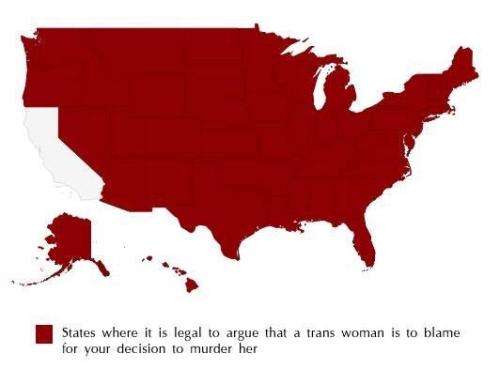
And if that happened in any state but California, the murderer's defense attorney would be able to legally argue in a court of law that Victoria was to blame for her own murder. That the defendant was "so shocked to learn that their victim was gay or trans that they had no other recourse besides violence." That Victoria shouldn't have been out in public as herself. That because she didn't hide who she was, she was more or less asking for it.

Who said I lied, because I never, I never
Who said I lied, because I never

When critiques ended, we were put on a short break. I went up to the guy who'd told the joke in the first place, and gave him one of my cards.

Nothing's changed
I still love you, oh I still love you 

A photo posted by Seranine Elliot (@aggressivefrontpocket) on

"I hope you know, I don't have any prejudice against anyone," he said. His body language said he didn't want my card. That he didn't need it because he didn't hate anyone.

Only slightly, only slightly less
Than I used to 

"Yeah, but we sometimes still say shitty things because we don't understand. I'm inviting you to get to know me," I said. "I blog about stuff like what happened in here earlier," I continued, as he took the card grudgingly. "Because I think it's important. I'm going to write about it soon."

And now I have.

Wednesday, May 27, 2015

Vehicular Faunacide

I definitely murdered a bunny with my car yesterday morning.

I'd woken up about two hours before my alarm was set to go off, so I had a comparatively lazy morning. I was doing all of the things I normally do to get ready, but at about 80% speed. Even though I got up two hours early, I didn't leave two hours early; I left about 90 minutes early.

There was some back-and-forth, as I checked and double-checked to see whether I'd forgotten anything. I came back into my bedroom to grab the novel my girlfriend had just bought for me, and headed towards the car. Then I remembered that I might need my tablet, so I turned around again and grabbed the tablet. And again to get a charger. And again, and again.

But I did eventually get out the door. I drove up to the gate, and got out to unlock it. Once I'd swung it open, driven through, parked again, and almost gotten it closed, I noticed that I'd neglected to put on any rings. I normally wear at least one, just for the look of it; a simple accessory. I only have a few, and they were all gifts, but I like trying to match them to whole outfits. But whatever fingers I'd put any of them on, I never put them on my left ring finger, because it has a cultural significance. When Kim asked if I wanted to be her girlfriend, after I'd gotten over flailing and squealing about that, one of the consequences of my "yes" answer was that I started making sure I wore a ring on my left ring finger every day.

This was not to say that Kim and I are destined to be married, or any other sort of farcical teenage dream. It was just a way for me to strongly suggest, to anyone who might want to hit on me, that I am no longer available to anyone else, romantically or sexually. Got it covered.

I hesitated by the gate, but then decided that I should just get going, because it wasn't a huge deal. I locked the gate, got back into my car, set up my GPS, and started driving. And before long, a bunny came shooting out of the brush to my left, and I made the tragic mistake of braking and changing my course slightly. Since the bunny did the same general thing at the same time, instead of being able to dodge where my car had been going, it got directly under the tires.

I suppose it died instantly. I certainly hope that it did.

I became extremely upset. I slowed down tremendously and agonized through tears over whether to turn back around, to see if the bunny had survived at all, to maybe take it to a veterinarian. I kept on driving, though, telling myself that since I'd been so sick the previous week, and not even at school (or blogging!), that I could not afford the time. I felt awful committing to that path. Committing to busywork while a creature I'd gravely wounded or killed was lying on the road.

A photo posted by Seranine Elliot (@aggressivefrontpocket) on

And then my mind did the thing that it's always done. It started suggesting reasons why this all happened. If I hadn't woken up so early. If I hadn't convinced myself that I could get into the school a couple hours before my usual time, and get some things done. If I hadn't forgotten to put on a ring. If I hadn't hesitated while debating whether to go back to the house and get one. If I'd just gone back to get one.

My mind invented this fantasy, that because I had neglected to put on the mildly culturally significant ring, I was being punished in some sort of cosmic, karmic sense. I had gone off course, and needed to be pushed back onto it by any means necessary. Sacrifices had to be made.

All of which is obviously absurd. But it does speak to our need to make sense of the world, and the events in it. People want to be able to say that everything happens for a reason, and to believe that utterly. It means that when commercial jets are being smashed deliberately into skyscrapers, there is some larger purpose. It means that when a kid you thought you knew starts shooting up your school, they're not just bitter or angry or from some kind of broken home where none of their emotional needs are being met, they are an Agent of God.

This is how religions start, by the way. And also bigotry. Someone somewhere sees something that needs an explanation. And in a particularly non-scientific way, they deduce reasons for that thing, and then select the most appealing one. I am positively bonkers about Kim. I suppose that means that on some level, I'm afraid of fucking things up, I'm afraid I'll lose her. How? Well, most likely by forgetting a trivial token accessory, apparently.

So this narrative gets constructed in my head, one where I am closing the gate and locking it as the bunny is kissing its family good-bye before charging across the danger zone to get to the really good food on the other side. Where I hesitate for some reason, and the bunny turns back and gets something it left behind in the warren. Where I depress the accelerator, and the bunny sees the looming clearing of the road on the other side of some brush, and a glorious field beyond that. Where I kill the bunny because there is a reason for it.

But the bunny didn't die for me. It didn't die for anything. It died because it could not survive the way the world works right now. It did the thing it was born to do — it died, and ultimately the best that would come of it would be that its body would be eaten by something else. And then passed. And then absorbed. And then absorbed again. And then eaten, and then eaten again.

Tragedies are called senseless, because they are. They are utterly without purpose. And so, inherently, are we. But we are also sentient, and can decide upon our own purpose. We can make our own meaning of life. Our own Meaning of Life, rather.

I calmed myself down by the time I got to Everett Station to jump on my bus downtown. I chatted with Kim a bit, I let myself be where I was, on the bus. A man with a bike got on after two other people had already loaded into the bike rack, filling it, and the bus driver let him just roll his bike into the front area of the bus. He told the man that if someone in a wheelchair boarded, he would have to kick him off, and the man said it was fine. The bus driver laughed, and said he was kidding. I smiled.

I went to both of my classes, checked in with my instructors about having been out sick the previous week, and left. My mildly transphobic friend Rich, and his wife, gave me a ride to Westlake Center, so I could catch my bus to Everett Station without having to walk anywhere dark or unsafe. As usual. Right as I rounded the corner from where they dropped me, I saw my route pulling up, so I ran. I got to the bus in plenty of time to board, and plopped into my seat, feeling fortunate to have gotten there right when the bus did.

The previous evening, Kim had been talking about friends of hers, and mentioned another trans girl who lives in Seattle, whom she'd met a few times in a few ways before finally just establishing a friendship. And when I saw her picture, I knew I'd seen her before, but I couldn't place where, at first. But then I remembered; she had written to me on my OK Cupid awhile ago, just reaching out to be friendly. And I'd written her back, more or less saying that I'd be happy to meet up some time, but that I was absurdly busy. But we had never really talked. When I got home, I messaged her from my OK Cupid, with my personal private Facebook URL, and told her that she knew my girlfriend, and that we should definitely hang out soon! So she added me.

We chatted on and off a bit throughout the day yesterday, mostly mundane stuff. But when I was riding the bus back to Everett Station, she asked me about confidence. She asked how I was so confident, how I could seem so cool and calm no matter what, because she did not feel that way, herself. My response, perhaps somewhat predictably, was to ask if she had seen Avengers.


With this conversation fresh in my mind, with the clarity of having put a major component of my life philosophy into words, I walked back to my car, alone. I saw a man standing by the Swift terminal, looking somewhat lost. I try to avoid mentioning this next thing, in general, because I think it's kind of bullshit that people insist on mentioning it when talking about someone even when it's not relevant, but it's actually kind of relevant, here. He was a black man. Relatively young, dressed in something that is probably close to what you are imagining right now. A lot of loose, draped clothing, and pretty nice headphones.

He said, "hey, excuse me, do you know how late Swift runs?" I went up to the map on the opposite side from where he was standing, found the schedule, and told him it looked like he had just missed the last one. It runs until 10p, and it was about 10:15p by then. His face fell. He was fucked. Proper fucked.

"Where are you trying to get to?" I asked him. "There's like a Home Depot near here," he began. "Near 128th? Airport and 99?" I said. "Yeah. I don't know. I think so," he replied. He didn't seem to be listening too closely. He was clearly distressed. As anyone might be if they were stuck at a bus station more than five miles from where they were headed, alone, at night. He was trying to call or text someone with a flip phone. A phone just like the one I had before I finally managed to fit a smartphone into my budget, albeit a shitty smartphone.

"I know where that is, do you want a ride? It's not very far, and my car is just over there" I said, pointing, smiling. He froze. I don't think that he necessarily even expected me to still be standing there talking to him, once I'd pointed out that he missed the last bus. But he recovered quickly, composed himself, and said yes, that would be great. He asked me to pull around and pick him up near where the bus we'd just gotten off of was, because he wanted to ask the driver something first (probably if there was any way he could get himself out of Everett Station at that time of night). We started to part, heading in opposite directions.

Turning, I said, "hey, what's your name?" when he was about 30 feet away. I couldn't quite hear him. "Kim?" I said, laughing to myself. Did this guy seriously have the same name as my girlfriend? "KEN," he said, louder. "Oh! Hi, Ken," I said. "Yeah, what's your name?" he asked. "I'm Sera," I replied. "Well, it's nice to meet you, Sera," he said. We both smiled and continued our separate directions again.

On the way back to the car, alone, in the dark, in a wide-open space that usually fills me with dread and isolation, I felt very alive and connected to everything. I was not really afraid. Fear was with me, as always, but that's the rest of the secret. I don't run from it, anymore. I sit with it and hold it and let it know that I'm here, and that everything will be okay. I was alert, don't get me wrong, but I was not on edge.

I got back to my car, and it occurred to me that, according to the precepts of American culture, I was making a huge mistake. I was a tiny white trans girl, and I'd just invited some random black guy to get into my car and let me drive him someplace. I thought, maybe he will kill me and take my... what, $20 or something. I don't really have anything much worth taking. Not that can be taken, anyway.

Maybe he will forcibly take my car from me, I thought. He was almost certainly stronger than me. I'm misleadingly tough, but also made of cupcake. Not the shitty, cloying, sweet kind. A nice fluffy kind that cannot actually hold anything up because it is basically just baked air. I supposed that if he did take my car, it would probably be because he really needed it.

I thought that, if I did die, people would notice right away, especially if the circumstances were awful. They would notice because I have been connecting with them. With so many people, especially in the last month or two. People would see the story of this trans woman who had been reaching out to everyone, everywhere, trying to help them all feel even just a little more okay. To help them feel safe and happy, to help them stay healthy.

I smiled, coasting slowly along the outside walks of Everett Station, and then I spotted Ken. I stopped to let him in, having already programmed my GPS to go to the Home Depot I thought he was trying to get near. He was on the phone with someone, asking about the cross streets. "On 128th?" he asked them. "Off of 99?" I asked him. "Off of 99?" he asked them, in turn. The destination confirmed, he said he'd be there soon, and hung up.

He started thanking me profusely, saying things like "God is great," and that my coming to help him when he was literally lost had some kind of greater significance. I of course do not believe any of that, but there was no value in my arguing the point. It helped him to understand his world and the way that it works, and it seemed to keep him happy and in a state of gratitude. I'm all for that, and I kind of don't care how people get there, as long as they're not hurting anyone else with it.

Ken asked how my day had gone, and I started to laugh. I explained that the day had been tiring, and that the entire last month or so had been such a whirlwind. Not a bad whirlwind, just busy and very much not at all what I'd been prepared for. We talked about how I learned my lesson about engaging with trolls on Twitter over the #BlackLivesMatter hashtag. In typical Sera fashion, I did not really ask him much about himself, which is something I need to keep working on. I'm very good at talking at people, but I'm still kind of crap at talking with them.

As we approached the Home Depot, he said, "I think this is the street I need right here, actually, if you wouldn't mind turning here." It was into a residential area, not terribly well lit. My terror levels did rise, I must admit, but it was by about a hundredth of a percent. By that time, Ken had heard about how I was going to go speak in Pennsylvania soon, to try to convince high school students that they should be nice to each other, basically. He had offered some suggestions about things to say, things very close to what I'd essentially already been planning to say.

It occurred to me that I felt more or less safe around Ken by that point because we knew each other's names. I'd given him one of my social cards. I didn't know every last detail about him or his life, I didn't know about the best or worst things he'd ever done, but I knew that he was there in my car with me because I'd invited him to be there. I'd invited him to be there because I did not want him to be stranded seven miles from his friends or family or whoever I was taking him to, and the thought of a lone black man having to walk that far alone at night terrified me. For him. It seemed like a great way for him to get himself dead in ways that keep happening for Black America, and that breaks my fucking heart every time I hear another story about it. And I think he knew that, too. I think that's why he was so genuinely grateful.

I dropped him at the entrance of the parking area for the complex he was trying to get to, and with the door open and the cab light on, I looked at him pleadingly, and said, "please stay safe." And he smiled and thanked me again, shook my hand, promised to look me up on Facebook later. And then he was gone.

The black man I'd invited into my car about 15 minutes earlier, whom I had not met or known in any way prior to that, did literally the opposite of everything our culture tells us that black men do. He was polite. He was kind. He was engaged and engaging. He was interested and interesting. He cared about trans people dying. He cared about black people dying. The common theme, of course, is that he cared. About people. Dying. He seemed grateful to me not for just giving him a ride, for helping him personally, but for the fact that I exist at all, and that this is what I am doing with my life. He was absolutely not threatening in the slightest, in any way — not in his body language or speech or manner, nothing. Nowhere. At all. And I wonder how many people can actually see that when they see a person who, at a glance, looks so very different from them.

All of this was possible not just because I am afraid all the time, but because I know it, and embrace it. I don't run from it. My response to fear is not to turn away, but to lean in. And lately, when faced with the possibility of doing something, anything, my response is, "that sounds terrifying. Let's do it." This is not thrill-seeking. This is accepting the worst possible outcome (or whatever I imagine that might be), accepting fear, thanking it for the warnings and advice, and then living my life anyway. Doing what I think matters anyway.

I want to help people. I want especially to help people who are often overlooked and underserved. I want to change that balance. It's a huge scale, and I surely cannot make it move much on its own, but maybe other people will see me trying, and join me. That's my Meaning of Life. To make the biggest and most positive difference I can before I die.

When I was finally almost home, I started to feel a bit agitated again. I was almost to where the bunny had been struck about 12 or 13 hours prior. I wondered if any good at all had come of its death. I wondered if my conclusion would be proven sound. I wondered if the body would be gone, most likely dragged off somewhere to nourish something else, something grateful, inasmuch as it could be, that the work of catching and killing had been done for it. That it wasn't so much that anything happened for any particular reason, but that whatever happened was ultimately going to work out.
 
The body was gone. Nothing has a purpose. But everything is going to be okay.