Showing posts with label transmisogyny. Show all posts

Sunday, October 11, 2015

Kindred

In February 2015, a League of Legends tournament operator changed a rule for their girls-only Iron Solari tournament: only one LGBT girl per team, or there would be an “unfair advantage.” Riot, the makers of League of Legends, had an immediate response.

When it comes to LGBT acceptance, Riot has been doing two things that have compelled me to write this, and write it now, and that is why I am not getting much else done today; because I just cannot stop thinking about all the ways in which this is coming together, and the ways in which Riot has been really really really clever. They are taking an audience that has a not-insignificant amount of bigots, and subtly causing them to shift and open their minds in ways that they might not necessarily feel comfortable doing directly with humans.

I don't remember when I started playing League, exactly, but it was definitely quite a while before I had my whole gender revelation. I would sometimes kind of take the game to task, among my friends, for some things that I saw as sort of like playing to tropes, playing to ethnic stereotypes, or playing to even gendered stereotypes. But Riot is not really any more guilty of that than most other media producers I've seen who are inventing original characters and original stories and original content around their game, or even just broadly, like comics or movies or whatever.

By that I mean things like the women being always thin, very fit, and the same with the guys for the most part, with a few exceptions. My earlier complaints would be things like, on the male side, with male champions, you have champions like Gragas, you have champions like Urgot, who are male, and definitely clearly masculine, but also in a kind of non-mainstream way, in that Gragas is very heavy, and Urgot is kind of grotesquely disfigured, and sort of half-human. There weren't really any female examples of that.

The women were all still really thin. There was some variance in breast size, and that was kind of it. But that was the starting point for something that's become really impressive. Waifish Jinx came out, and she had very very very small breasts. She was the first female champ that I remember seeing who wasn't a child, like Annie, with such a small build. It was nice to see some variety come in.

But in the last six months or year, Riot has really started to get creative with their champions. They are challenging their community's capacity to understand things outside of gender binary, and outside of culturally normalized gender roles. They are doing this by presenting new champions who don't look like what the audience thinks someone who uses pronouns like "she" and "her" should look like, but instead just presenting someone who is that way, in a world where that mostly doesn't matter. They have the ability to do this because it's a fantasy setting. They can come to their audience with a character that is not human at all, where all of the extranormative things about that character are so out there that their gender becomes the least confusing thing about them.

The first example of this, which was kind of impressive, but didn't blow me away as much as the one I'm going to get to, is Rek'sai. Rek'sai is female, an alien monstrosity... uh, thing. She's this rapidly-tunneling land-shark sort of creature that's kind of short and squat and really wide, but she also will literally pop up out of the ground under your champion, and take them to pieces.

On the forums, there'd be some discussion, where people would say things like "I wonder when he will come out?" or whatever, but when Rioters would speak about her, they'd gender her correctly because that's a matter of brand consistency, if nothing else. Riot is clear about what Rek'sai is. There is no ambiguity about her gender, but a fair sized segment of people see a character concept like Rek'sai, and they want the gender to be masculine because of how she looks. Even so, whenever she was misgendered on the forums, there was always a response from someone in the community correcting that.

So we have people getting used to this model of understanding two things. One is that if someone misgenders someone else, it's appropriate to correct them, and two, any idea of what is required for someone or something to be female is challenged. For non-humans, we don't get hung up on this as much in reality. You see a girl dog, and you think it's a boy, and you say "how old is he," and they say, "oh, she's two," and you say, "oh, 'she,'" okay, great. No big deal. Minor mistake, it's fixed, nobody cares, and the dog never had any idea.

But in fantasy settings, we have the advantage of creating something entirely new that's outside of everyone's understanding or experience, and saying, by the way, this thing has gender, and even though your expectation based on appearance is that her gender is male, it's not; her gender is female. And that maps really pretty closely to the thought processes that are required to get your head around trans people being legitimately whatever gender they understand themselves to be.

One of the difficult things in educating people about what being trans looks like is managing any expectation that people think about these things if they don't know any trans people, or anyone else that is really outside of the realm of their experience, outside the realm of their day-to-day lives. If they don't have a reason to know about it, if they feel they don't have a reason to have the vocabulary about it, it can feel kind of oppressive to have someone come in and say, "you need to behave this way, you need to refer to me in that way." Rek'sai gives Riot a way to get people to do that without feeling so opposed to it, because League of Legends is something that they've come to of their own accord.

People are showing up and playing because they love the game. Whether they love the mechanics or the lore or the construction of the world, the way that the maps are designed, whatever it is, they want to be there. They're invested in it. And Riot, the people who have created that world, are able to dictate some parameters of that world, and say, "this is it, this is the world, so, take it or leave it." And they have enough of a customer base, they have a good enough product in terms of a value proposition in gaming, that they can get away with that.

The thing that really impressed me, though, was not Rek'sai. I didn't even realize all of these subtle things about Rek'sai until recently. The thing that's impressed me a lot more is this teaser of a champion that's not out yet, as of this writing, called Kindred. Kindred, if you look at the concept art, is designed as two spirits. Which itself un-subtley refers to a widely understood queer and/or transgender model; the Native American two-spirit.

Kindred is plural, a pair of beings who are never without each other, who cannot be separated further. They are two, but they are atomic. They are two, but they are one. And in the cinematic teaser, Wolf has a voice that might be described as male-typical, and Lamb has a voice that might be described as female-typical. And they also have sort of more stereotypically masculine and feminine sort of properties. Wolf, as one might guess, is the more masculine energy side, more aggressive, feral, direct action, attacking stuff. And Lamb is more overseeing, caretaking, with a healing aspect that is represented in "Lamb's Respite," Kindred's ultimate ability. But because they are two, even though it's a singular entity in terms of game mechanics, the pronouns for this champion are "they" and "them" and "theirs." And so, I've seen already on the boards, people will pronoun Kindred as "he" or "she," and sometimes they are corrected. And when corrected, sometimes there is a pushback. But in this case, there's no ambiguity about the character's pronouns the way there may be some understandable debate about them in reality, because Riot controls the reality of Runeterra, the game's setting, absolutely.

Riot doesn't need to police the forums and go in and correct people misgendering Kindred via pronouns, they can just keep using those pronouns consistently in all media regarding the character. In this way, they also set a great example for trans people in managing reaction to being misgendered in their own lives; if you are misgendered and you correct someone, there's a chance you'll have some pushback, and it may even become relatively violent. But, if you just keep asserting yourself, people will probably come around eventually, and even if they don't, your allies will reveal themselves. The other thing that's really obvious as a call-out to this sort of two-spirit model, which is really heavily influenced by gender, is the symbology that's used for the masks that Lamb and Wolf wear, and even their own coloring, which are both plainly inspired by the yin and yang concept. With the darker shade of coat and the lighter tint of mask, Wolf is plainly masculine with an aspect of feminine, in terms of visual composition, and is established in opposing balance with Lamb, whose colors are reversed.

This is really impressive to me, that a company that has this size of an audience, an audience that has a lot of people in it who are really transphobic, biphobic, take your pick... non-cisgender-heterosexual-phobic... has been releasing champions that challenge our notions of gender. I saw something on the boards the other day, where this trans girl was being bullied about her appearance and the fact of her being trans. I reached out to her and was like, "hey, I'm here for you." It was important to me to be sure that she knew she was not alone, because being rejected so broadly leads very quickly to a sense of alienation, a sense of isolation, a sense that maybe who we are is wrong, when nothing could be further from the truth.

She seemed confused by this, and a little bit defensive, which is understandable given the kinds of introductory messages girls like us get online. I went on to say, more or less, "this is me, here's my Facebook page if you want to get to know me at all, but I'm mostly just here to let you know that I'm here for you, and that's it." And I left her alone after that, but she's initiated chat with me since then, and I feel like I've done a good thing. I reached out to her in the first place because her forum name and summoner game name is very much "I am female," and her post on a selfies thread on the general discussion board had people saying things like, "that's not a trap, that's an ambush," which is referring to this idea that a trans girl is trying to "trap" someone, or trick them into thinking that they're a "real girl," as if they were anything else.

Somebody else posted this sort of trollface or grossed-out kind of face cartoon drawing, that said "cross-dresser" under it really large. There's definitely a lot of vitriol around girls like me in gaming communities in general, and specifically within League's community. But Riot, for its part, is saying that they don't agree with that. They're not just passively saying "hey, we don't like that," but that they're completely opposed to it in their corporate philosophy.

This was really illustrated clearly in February, when a tournament operator called Garena, from the Philippines, was changing some rules around their Iron Solari tournament. The Solari in game lore are represented in Leona, who has sun-themed abilities and iconography. So the Iron Solari tournament, inspired by that, is a girls-only League of Legends tournament.

Very briefly, as in "in the course of 24 hours" briefly, in February, Garena issued a statement saying that they had heard from a number of their players that perhaps if a team had a lesbian or bi or transgender girl on their team, that they got an unfair advantage for some unknown reason. The text of the announcement literally said "may probably have some unfair advantage." They of course got a backlash from people in the community, but then they had a pretty strong and unsubtle backlash from Riot themselves.

Riot tweeted an unambiguous statement that "LGBT players are welcome at official LoL tourneys. We're working with partners to ensure consistency with our values across all regions." In other words, if you do not allow unrestricted access to LGBT players at your tournament, it will not be an official League of Legends tournament. And if you don't have the support of League of Legends' publisher for your League of Legends tournament, that is a big problem.

The next day, Garena rescinded the rule, saying they "sincerely apologize for any offense we caused to the LGBT and gaming communities." It had the usual corporate non-apology trappings of how their initial decision "created a lot of good discussion and debate," and how they had been "discussing the ruling with our partners and re-examining our approach" and ultimately changed their minds, but it was pretty clear what happened.

Maybe, I don't know, six months after Kindred's come out, it will be really natural for people to refer to someone that they understand as a single entity as "they" or "them." So when they meet a non-binary person after that, now they have a model. Instead of having a reaction of "that's crazy, that doesn't make any sense," they have this concept they can attach it to. It might not be completely accurate or relevant, but it will be in the ballpark. Someone can say to them, "hi, my name's Chris, my pronouns are they, them, and theirs," and instead of having no idea how to respond, now the listener can think, "oh, they're like Kindred, okay."

And then everything is easy. Because they've already had conversations with their friends about Kindred, as a champion, and because Riot is very clear about "this is the grammar," and "these are the words," it gives people a way, through play, to flip that switch, and get their heads around saying something like, "we need Kindred to come and gank top, we need them to get there fast." And then they meet someone who's non-binary, and suddenly it's not that hard for them to talk to their friends about this person, or to use their pronouns properly. If their friends play League, too, there's no need to go into an explanation that they may not feel equipped to give. It just becomes normal, or at least more normal, and less alien.

They can say, "I was hanging out with Chris last night at their place, we had pizza, and they were like, 'do you want Mountain Dew, or Coke?' and I was like, 'I want vodka,'" or whatever. The pronouns disappear, mechanically, and the message is conveyed because the hangup of using a pronoun that deliberately keeps some aspect ambiguous, or defined as "outside of the Gender Binary," disappears, too. It normalizes the use of non-binary pronouns, which is fantastic. Non-binary pronouns are something that I still struggle with. Like most people, I have been encultured to presume gender and assign it mentally, even to people I will never interact with at all.

If I see someone on a bus that appears outwardly feminine to me, and I tell a story about them later to a friend, I will almost certainly refer to them as "she," even though that may not be accurate. I have non-binary friends whom I still instinctively read as male or female, and having an extra model in my head to associate them with reduces that.

I know very few non-binary people, and it's difficult for me to correctly use their pronouns. It is sort of alien to me. And I also understand that they're right, and that the problem is me, and not their identity.

This is the genius of what Riot is doing with these kinds of champions, like Rek'sai, and Kindred. They're saying, "Rek'sai is she. Kindred is they." And that's it. They don't have to come out and have Rek'sai say "my pronouns are she/her/hers," they just always consistently state them that way. Because that's what they are.

Monday, July 20, 2015

Stop Me

Oh-ho-ho stop me
Stop me if you think that you've
heard this one before

"What's Victoria's Secret?" he asked.

Nobody answered.

"She used to be Victor!"

I heard this joke this morning in my Design class. It was very upsetting right off the bat, and I found myself reacting, instead of, as I prefer, responding.

As the collective groans went up, I said, over the top of them, "oh, wow, great, transgender jokes. Hilarious." The room went dead silent. We locked eyes, the student who told the joke and me. He started to stammer.

"Oh, I didn't mean anything offensive by it," he managed to spit out.

"Yeah, but it was offensive. It's really gross, actually."

"Okay, but I didn't mean to offend anyone with —"

"Usually, when people offend someone else, they will —"

"I apologize."

"Thank you."


Class resumed. We had assignments due this morning, so we had all put our projects up on the back wall and were preparing to talk about lines and continuity and contrast and emphasis. When the instructor handed me a jack-o-lantern bucket to put my grading sheet in, I didn't understand that I was supposed to fold my paper into quarters, and then also pass the bucket around.

"I'm sorry," I said to the teacher, after he'd explained it directly to me a second time. "I'm a bit distracted."

"Yeah," he lamented. "Sorry about that."

"Oh, I'll be fine," I answered, passing the bucket along.

"This is how we can tell you never went to church," my friend Erica quipped, trying to cheer me up.

"Is that the giveaway?" I smiled back at her.

Critiques went on, but I kept mulling over this problem in my head. I knew the joke was offensive, and even the guy who told it knew. He'd let it slip before considering the audience. I've done that millions of times. I have a lot of room to forgive that construct on its own merits, because I know it so well. I also usually have a lot of room to forgive ignorance. After all, a year ago, I might've made the same joke, because I had the same ignorance. (Remind me to tell you some time about how my Ok Cupid dating profile, right up until I realized I was a girl and shut it down, contained the term "she-male.")

I'm sure that the guy who told the joke thought it was a harmless play on names. And many trans women do adapt their birth names into a feminine form. In a space like this, where I felt empowered to speak up because we were at a school with "Safe Zone" and "Trans Safe Space" stickers everywhere, where I felt like there was institutional readiness to defend me, where I was not afraid of repercussions, I was able to challenge the joke. But I wasn't able to quite explain why it was offensive, only that it was. And that's what made it a reaction and not a response.

I had more reactive thoughts, but I was able to recognize them for what they were pretty quickly, and, after biting this guy's face off, I was able to reject these thoughts, to refuse to act on them. I'd remembered how, for example, at The Art Institute of Seattle, I was told to go directly to the Dean of Student Affairs if anyone gave me any abuse for being trans, because the school had a zero-tolerance policy on that kind of behavior. Which means that, had this been a class there, I would've been within my rights to have this guy removed from the program, removed from the school entirely, for not realizing that the joke he was about to tell was offensive before he told it, and then not ever actually telling it.

And I feel like that's a bit extreme. It's like when we have a passenger plane shot down by an RPG in the Middle East, and three Americans and a Canadian die, so we send in The Whole Fucking Army and bomb the shit out of the village the RPG was fired from, and then install a new mayor there, bring our soldiers home, and promptly ignore their PTSD and missing limbs. It's not an appropriate, proportional response. It's a reaction, a gross overreaction, and it makes everything so, so, so much worse. While critiques were in progress, I sussed this all out. And now, I have my response.

This joke isn't just offensive because it mocks and then erases Victoria's own narrative, whatever it may be. It's offensive because it gets people killed.

This same joke, told in a different setting, say, a bar, about a woman who is actually at the bar, can also be meant to be harmless and inoffensive. Maybe the one telling it has the sense that it's cruel on some level, so they make sure that the woman at the bar can't hear. Maybe someone who does hear it is a drunk guy who had been trying to work up the courage to go ask her if she comes here often.

Now, while his judgment is impaired, he is challenged with things he was not prepared to be challenged with. "If she 'used to be Victor,' then she was born a man!" he might think. "Does this make me gay?" he might think, which is usually not happily followed with, "oooo, I should figure that out for myself," but rather, "I'm no faggot." With fear and loathing. "Maybe instead of one of us, I'm... one of them."

Maybe Victoria only feels the mood in the bar shift out of her favor. Maybe she only notices that all the friendly, interested glances have turned to confused and angry ones. Maybe someone blocks her way when she tries to go to the bathroom, and insists she use the "right one," the men's room, instead. Maybe she ends up not going to the bathroom at all. Maybe she goes home, safe on the outside, and kills herself. Or maybe she's dragged into the men's room and forced to go. Or maybe she gets beaten up. Maybe she gets raped. Maybe she gets murdered.

That's a lot of maybes. But not the imaginary maybes of trans-women-are-men-who-want-to-attack-our-daughters-in-bathrooms. It's the maybes that are very plausible backstory to the kinds of killings that keep on happening. Whether some guy at the bar actually destroys Victoria, or whether she learns to hate herself so thoroughly that, in the end, she destroys herself, these jokes, these mock narratives, are often key elements of the setting. Sometimes they move from the background to the foreground, and become catalysts.


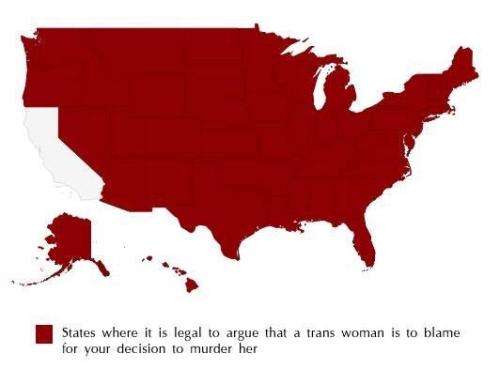
And if that happened in any state but California, the murderer's defense attorney would be able to legally argue in a court of law that Victoria was to blame for her own murder. That the defendant was "so shocked to learn that their victim was gay or trans that they had no other recourse besides violence." That Victoria shouldn't have been out in public as herself. That because she didn't hide who she was, she was more or less asking for it.

Who said I lied, because I never, I never
Who said I lied, because I never

When critiques ended, we were put on a short break. I went up to the guy who'd told the joke in the first place, and gave him one of my cards.

Nothing's changed
I still love you, oh I still love you 

A photo posted by Seranine Elliot (@aggressivefrontpocket) on

"I hope you know, I don't have any prejudice against anyone," he said. His body language said he didn't want my card. That he didn't need it because he didn't hate anyone.

Only slightly, only slightly less
Than I used to 

"Yeah, but we sometimes still say shitty things because we don't understand. I'm inviting you to get to know me," I said. "I blog about stuff like what happened in here earlier," I continued, as he took the card grudgingly. "Because I think it's important. I'm going to write about it soon."

And now I have.

Sunday, April 19, 2015

#RealDeadTransKid

Today (yesterday) had been going a little slow.  I didn't feel particularly well, but I had a lot of homework to get done, so I was really trying to focus hard on that, even though my body was making that especially difficult.  Nothing to do with gender dysphoria, just some run-of-the-mill living human kind of stuff.  I was actually starting to finally feel a little better when I saw the news that Taylor Alesana had killed herself.

I clicked through to the article, and I read down to the end, and started to well up a bit.  It was sad.  It was as sad as every other trans girl's needless death, by her own hand or someone else's.  But I felt a little numb to it, at the same time.  When Leelah Alcorn died, I also felt sad, but her death had hit me harder than most.  I had not written any new (pop) songs since my own gender revelation, primarily because nothing was really that horrible in my life.  Even the bad stuff, I was weathering, and coming out okay.  I had nothing so miserable to write about anymore.  Until Leelah died.

The way that I found out about Leelah was what really turned the news of her death into an absolute suckerpunch.  I had been browsing tumblr that morning, and I saw some trans girl's selfies of 2014, or whatever.  I reblogged them and followed her, as I tend to for anyone I am sure is a trans girl.  And then a little further down, I started seeing posts about someone named Leelah Alcorn, or maybe it was Joshua, but were they male, or female, who was saying what, I didn't know.  Then I found a post with a link to her suicide note, and I was stunned.  Because it was her.  It was the girl I had just followed.  The one I'd been looking forward to supporting and encouraging.  The one who had a build just like mine.

I felt sick.  I felt numb.  I remember wanting very much to cry, but not really being able to.  I had something inside me about it that needed to come out, and ultimately, it was a song.  The first (and so far last) miserably depressed song that I've written since becoming basically happy most of the time.  I had experienced challenges that would impact my mood since it had stabilized in a much better place, but I had not run across anything like this, any really traumatic event.

I joined with a lot of other trans people and tweeted under the hashtag RealLifeTransAdult, to try to help trans kids who were stuck in a hostile environment just keep their eyes on the future.  But mostly I just kind of packed it away into the back of my head somewhere, and kept on just trying to work on me.  Just finishing the degree so I could start fixing my own life to the point where I could start helping others.  To be able to fight from a position of power, or at least not from a position of such absolute weakness and vulnerability.

Taylor's suicide brought all of what I had stuffed away when Leelah died back to the forefront of my mind.  I briefly examined my reactions, wondering why I was feeling so incredibly affected by these two girls, but less so by so many of the other trans girls' deaths that I read about, and reblog.  I wanted to be accountable to myself if I had some kind of unexamined, racially-motivated bias.  And I decided that that didn't really fit.  It didn't feel right.  Because every trans girl's death hurts.

I have never been close to my immediate family.  Trans girls everywhere are the closest thing to family that I have.  That means some of them drive me insane, others inspire me; some have personalities that I struggle to deal with, and others just click with me right from the start.  Some of them I just don't really have strong feelings about one way or the other.  That is, I like some, I dislike others, and am ambivalent about the rest.  But I love them all.  Because they're my family.

When a trans girl dies, I realized, how much it impacts me has to do with how closely I feel her life experiences map to my own.  With Leelah, it was the broader sense of total rejection from parents, a refusal to acknowledge who she actually was.  That was, again, broadly, my experience growing up.  My parents never had any interest in getting to know me.  They had a plan for me, and I wasn't in on it.  The further I drifted from it, the less they loved me, until finally, there was nothing left, and I was just taking up space at home.  Leelah's death, with those immediately apparent first details of her parents rejecting her, struck a chord with me.  So her death felt like the loss of a little sister that I had just been told I had.

With most trans girls, there aren't such potent emotional hooks that resonate specifically with my own life.  These deaths feel more like the loss of a distant relative.  One I may have seen from afar once or twice at the annual family reunion, or whatever.  A loss that I feel, and a person that I will miss, and a shame, but less hard-hitting for me, personally.

Taylor's death felt like that, at first.  I read the article, and welled up a little bit.  I got a lump in my throat, and a couple tears fell.  Maybe a few.  But I didn't feel too terribly much in common with her specifically, beyond the fact that we were both trans.  And then I watched her video.


And it shouldn't have hit me as hard as it did, because the thing that made me feel really connected to Taylor was at the very end.  It was just word choice, on her part.  Telling us about what she hoped to accomplish in the near future, and then saying "wish me luck!"  It's not even a trans phrase, it's just a thing some people say when they're about to try some big thing that means a lot to them.  It's the same thing I've been saying a lot lately.

I completely fucking lost it.  I had been tearing up a bit throughout her video, but at the very end, I was absolutely done.  I had spent the previous hour or so doubled over in my chair, trying to convince my guts to relax, so I could just sit up like a normal person and get some homework done.  And there I was, doubled over again, but sobbing relentlessly, this time.  And, objectively, in far more pain.

I ended up stumbling over to the bed.  I couldn't see very well.  I sort of fell over and scattered cats everywhere.  Cream Puff Cow came up to me and started head-butting me gently while I cried.  He's such an idiot when it comes to basic things like, "which way did the ball go that I just watched roll right past me?" but he's probably the most emotionally tuned-in cat I have, and one of the better ones I've ever met in my life.

A photo posted by Seranine Elliot (@aggressivefrontpocket) on

Sorry, I start to really babble when I'm upset.  It scatters me.  Um.  Yeah, so, anyway, I was sobbing on my bed, and I just started asking Cream Puff Cow, of all people, "why?"  A million variations on the same question, for about an hour.  But, in between sobs.  I was probably not intelligible, but that was okay, because he doesn't understand English, anyway.

Why do people hate us so much?

What have we done to make anyone upset?  What?  Besides being born this way?

She just wanted to help people learn how to do their makeup better.  Who could that have possibly hurt?

Why do they keep killing us?

And we all know the answer, right.  It's because we're different.  And it's the dumbest thing in the world.  We are steeped in this culture of celebrating diversity in theory — thematically in stories, whether in music, text, or video with coming-of-age and fish-out-of-water archetypes — but burying it in practice.  We want to see and celebrate diversity, but we only want to do it from afar, and we only want to do it with people that we can find pleasing in enough ways to offset the things about them that we do not understand, things which may disturb us.

And I get that.  I just wrote about it.  People who are different from us can sometimes seem so different that we get freaked out.  What we do with that feeling defines us.  When we are children, perhaps we respond by making fun of some aspects of that person that we think tie into whatever it is about them that we can't get our heads around.  Of course, once the belittling starts, the target is gradually perceived as less and less human, and let's be honest, they didn't rate very high to begin with.

Believe it or not, I was actually part of bullying a kid in my middle school.  Not an especially active agent, but active enough.  Certainly not passive, and definitely not in opposition, which is where I really wish I could say I had been.  There was a Korean kid in our grade who had some kind of mental or emotional disability.  Possibly something developmental.  I never really found out.  Some of the other kids would get really nasty with him, physically violent.

I never got that bad, but I wasn't much better.  Whenever someone made a crack at his expense, I laughed.  Yeah.  It was hilarious.  This kid is different.  What could be funnier.  I probably made some cracks, myself.

One time, another kid in our grade held him, suspended by his ankle, over a stairwell, a one-story drop.  I have no idea why.  I walked up on this scene, and I can't remember doing a thing to stop it.  I can't remember even wanting to.  It was scary shit, looking back.  Some real Lord-of-the-Flies shit.

But my real motivation, if I can be honest with myself, wasn't so much that I hated the Korean kid for any particular reason.  It was that I was so relieved to not be the target.  I was so relieved that nobody was coming at me for my bad teeth, or my shitty haircut, or my cheap hand-me-down clothes from my older brother, which had probably come from a thrift store or fucking K-mart before that, anyway.  I was relieved that I could just be another asshole in a sea of assholes.

Because I knew.  I fucking knew how much it hurt to even think that other people didn't like me.  To even think that they were talking about me behind my back, making fun of me for god-knows-what.  Being poor.  Being short.  Having glasses.  Being shy.

I was once happily flirting with a girl in one of my classes.  And I do believe she was flirting back.  We were just chatting and being silly, not thinking at all about where anything might go.  We hardly knew each other.  It was the middle school equivalent of meeting someone really cool at a bar.  Except that at this bar, her friend showed up, and asked her, without even looking at me, "when are you gonna stop talking to this nerd?"  This was probably around 1987, and when someone called you a nerd in 1987, it was not a term of endearment.

The thing is, I know everyone in the entire world knows what it feels like to be the target.  To be the object of ridicule.  What I don't know is why, when we realize that, we keep being so fucking awful to each other.

Try to imagine the lives of these girls.  Imagine knowing who you are, absolutely, unquestioningly, to the very core of everything you are and have ever been.  The way most people do.  Knowing your gender.  The way most people do.  Feeling secure in at least that, if nothing else.  The way most people do.

Now imagine being challenged on that everywhere you went.  From the moment you woke up and your parents denied your identity.  To the bus stop where all the other kids ignored you, except when they all turned your way for a second to stare, before returning to their circle to burst out laughing.  To school where you get beat up in one bathroom, but looked on with disgust in the other, as if you were some kind of awful beast.  To lunch, where no one would sit with you.  And then back home.  To start it all over again the next day.

At first, you might fight back.  After all, you know who you are.  It's so obvious.  To you.  It's the truth.  So you fight back.  Someone calls you "faggot," you pick whatever you think might hurt them the most, and throw it back.  Maybe it's "nigger," or "chink."  Maybe you point out that they were adopted.  Maybe you ask if they still live in a trailer.

Eventually, you get tired.  You can't fight forever, so you stop fighting.  But they don't stop attacking.  You stop feeling, but you keep taking damage.  And before you know it, every day is misery, and you long for death.  You long for rest.  You long for freedom.  You long to be treated and seen as the person you know yourself to be.  Your mind becomes very adept at shutting down positive trains of thought, and it becomes more and more fatalistic.  Until finally, it kills you.

The next time you feel uncomfortable around someone, ask yourself if they're actually doing anything that warrants discomfort.  Are they charging at you, brandishing a frozen-solid slab of albacore, while not wearing any pants, covered in cat shit and Goldschläger, screaming about the motherland?  Feel disturbed.  Be okay with feeling disturbed.  Because that is some weird shit.

But are they just sitting there, having lunch?  Are they just washing their hands in the restroom, not making eye contact, and clearly hoping to GTFO ASAP?  Are they, in any other words, just existing?  Because if that makes you uncomfortable, please be honest with yourself and realize that the problem is not that they exist, but that you are reacting in some particular way to that fact.  And when you see other people who feel uncomfortable around that person starting to take it out on them, think long and hard about what you wanted the last time someone laid into you for basically just being who you were.

Monday, March 23, 2015

Man-face

Let me preface this by saying that if you’re planning on sending someone fan mail or an ask telling them that they have masculine facial features, you should probably make sure they’ll take that as a compliment, first.  You know, if you see a trans guy (or a cis guy for that matter) saying, “I just feel like I look really girly all the time,” that is the perfect time to write and say, “you have really masculine facial features!”  There is really probably no time that that will ever be a thing I would be happy to get from someone on tumblr.  Or anywhere else, for that matter.  Believe me, every trans girl knows exactly how well she passes (or doesn’t), and she also knows, in great detail, why.

SO, with that out of the way, I will now tell an epic tale that spans the weekend.  Some of you may read this and vilify me, and I suppose if that happens, it happens, but I would ask that you consider the fact that I am taking a look at a lot of reflection, and working through my own feelings and thoughts and conclusions about a lot of things right here, in what is essentially a public forum.  I cannot really take anything back, but, being human, I do reserve the right to change my mind after further thought or discussion, and I hope that you will all allow me that, at least.  I know that I’m not perfect.  This is me stumbling towards perfect, towards the end of the rainbow.

On Friday morning, when I got to the VA hospital, I checked in and then rushed to the restroom, like usual.  As I was washing my hands, I looked up and caught a glimpse of my face, and it just looked super masculine to me.  I don’t know why, exactly.  I talked to a few friends about it.


Jenn pointed out that maybe my jawline hardened when I was tired or stressed, but then revised that to say that when she sees me with stressed or unhappy faces, she sees Jason.  Which made me laugh, quite hard, and I took pictures to show her.  And she said, “there, see?  Sera.”


It was nice.  I recognized, on some level, that my actual face and appearance had probably not changed much from the previous day, and that it was much more reasonable to conclude that I was just having a Bad Self-perception Day, and not a Man-face Day.

After that, I had a few other interactions that gave me pause.  The first was with two other trans women in the speech pathology Voice Feminization Program group.  Both were older than me, by about 25 years for one, and what had to be more than that for the other.  Zelda looked like she had started to transition very very late in life, and had a lot of physical hallmarks of masculinity, such as very broad shoulders and a generally inverted-triangle physique.  She also, like the rest of us in the group, didn’t sound particularly feminine when she started talking.

I cannot remember the other woman’s name.  She was old enough that most of the gendered physical markers were obscured, and it was not until she started talking that it was very obvious that she was trans.

I wasn’t sure how I felt about these two women.  Zelda, in particular, was extremely chatty, enough that it was a constant disruption to even our very tiny group of three.  I found her very annoying, but I wasn’t quite sure why.  I found the older woman unsettling, and I wasn’t quite sure why.

Not long after the group ended, I thought about it some more, and concluded that it must have to do with their capability to pass.  Or not.  And I realized that, for myself, I identify with the binary gender framework.  For me, having to describe myself as basically male or basically female works, because I see myself as basically female.

I am caught in this position where I feel like my capacity to help other people understand just how damaging the binary can be is diminished, because, while I am on the opposite side from where people might try to put me, I do still inherently see myself as one side of that yin-yang.  Mostly feminine, tiny dot of masculinity, and no other terms necessary to describe me.

This gets into part of why I feel particularly fortunate in many aspects of my own transition.  For example, I have never had very broad shoulders or an otherwise obviously masculine body.  It’s always been pretty androgynous, and, now that I’m on HRT, it is starting to become more and more apparently feminine.  I can see, under the shadow of all the facial hair that I still have, how my face will look when it’s all gone, and has been gone for months, long enough for the skin to return to its normal color and texture.  I can photoshop out my adam’s apple in my mind.  I have a pretty good idea what I will look like after my surgeries and treatments are all done, and I am looking forward to getting my body there.

Passing matters to me.  It doesn’t matter so much for safety, although that’s a concern; it matters because so much of what is left of my gender dysphoria in terms what triggers I experience has to do with the disconnect not between my own body and mind, but between my understanding of society’s perception of me (a not-man that thinks it is a woman), and my own perception of myself (a woman who is trying to get everyone else to understand that she’s a woman).

Passing is not super important to everyone, and I respect that intellectually, even while I have trouble empathizing or identifying, because it is not my experience or understanding.  The degree to which trans people can pass is such a cosmic lottery to begin with that I cannot in good conscience dog anyone for how well they pass or don’t, or how much importance they put on it.  Nobody should be put down for anything that is so greatly out of their control.

At that point, I had to really consciously face an uncomfortable truth, which is that trans people tend to freak me right the fuck out.  The huge, huge majority of trans people I have met have struck me as “weird” in some ineffable way, and my best guess at this point is that what I crudely summarize as “weird” is my observance of behaviors that are intended to facilitate passing, but which, in my view, fail, and fail dramatically.

In trans men, I have mostly seen an adoption of hyper-masculine behaviors, which are, predictably, all of the toxic ones.  These guys adopt a lot of really awful methods of interacting with the world in general, and especially with women.  In trans women, I have mostly seen a far less destructive, but still unsettling, propensity for constantly declaring their gender and/or sexuality.  Constantly.  Not in a setting that is gender- or sexuality-focused, like a support group or something, but in settings that are so furiously mundane that literally nobody else is even thinking about their sexuality or gender.  The weird thing becomes not that they are women whom society, to varying degrees, views as men, but that they are going on about a subject that nobody else is even thinking about.

In these ways, most of the trans people I’ve met seem almost cartoonish in their attempts to fit in, simultaneously adorable and pitiable, but also profoundly unsettling.  They (that narrow pool, the majority of trans people whom I have met in person) remind me of little else so much as primitive robots who are desperate to look human, so they can fit in and not be treated like trash, like sub-human things that are there to be mocked, at best.

I try to work on developing compassion.  If I can’t understand, I want to at least be able to accept.  I remind myself that if I had been born with their genes, if I had lived their experiences, I would ultimately do the exact same things in the exact same way.  I police myself and try to make sure I am not a klaxon that sounds “WOMAN, WOMAN, WOMAN” over and over.  I cringe when I see someone else doing it.

All of this sounds very harsh, I know.  But understand this.  Like most people, the things that upset me the most are the things I dislike most strongly in myself.  I realize that I am not really being directly unsettled by my conclusion about someone’s capacity to pass or not.  I am unsettled because seeing someone else trying to pass calls into question my own capacity to pass.  Or not.  And that terrifies me.

It also frustrates me, because, as I said, I have pretty high expectations for how things will go overall, for me and my own transition.  I honestly believe that I will reach a point, probably in about 2-3 years, where people will not know I am trans unless they already knew, or unless I go out of my way to tell them.  Being around other trans women has, thus far, in general, left me feeling like I’m winning a contest I don’t even want to be in, and I hate that that is the sensation that I get out of these encounters.  That I feel compelled to pity someone who may want nothing of the sort from anyone, let alone me.  That I feel inherently superior on the basis of a social rule that disgusts me.

On my way out of the building, a nurse flagged me down, and told me about how I had come up in her conversation with a colleague the other day.  I did not remember her, but she said she had checked me in to the speech pathology clinic the last time I had come to the hospital.  Apparently I was wearing one of my three pairs of cat tights that day, too.  She had told a co-worker about checking me in, and said “he had the cutest cat tights on.”  And then, she told me, her co-worker corrected her, saying, “no, she had the cutest cat tights on.”

She was upset, because she wasn’t sure how to categorize me.  This is where the binary gets to be a problem.  For her, understanding me as a woman and not a man is a big enough mindfuck.  If she were to have to try to understand me as something other than the only two concepts of gender that she knows, she’d really be in trouble.  As would most people, I imagine.

Complicating matters is the fact that the VA has managed to update only part of my records.  So, while the files almost all say “Seranine Elliot,” they mostly also still say “Male.”  She would look me up to check me in, and it would say, “Mr. Seranine Elisabeth Elliot,” which might be one of the dumbest things I’ve ever heard.

But, being a conscientious nurse, she wanted to be helpful, and not offensive or insensitive.  So she asked me, what is she supposed to do when she is faced with that kind of disconnect?  And how does she know the difference between a trans woman and a drag queen?  I told her that I was glad she asked, because my dream job is to be a sort of trans ambassador to the cis world.  To show them that my being trans is kind of the least interesting thing about me.  And then I told her that I didn’t really know for sure, because everyone understands their own gender differently.

I did advise her that if someone who the records say is a “mister” shows up in 100% clothing and makeup that is made for and sold to women, that person probably sees herself as female, and would probably like to be addressed and interacted with appropriately to that.  I also told her that if she wasn’t sure, she could always just ask, “what are your pronouns?”

I got her email address for a lead on how to potentially impact policy for VA Healthcare in regards to trans veterans, and I will elaborate to her in that way that if someone she might guess is male is presenting as female, and it’s in their daily life, and not for a performance of some kind, that she is probably a trans woman, and not a drag queen.

Anyway, we went on to talk about fashion for awhile, and I told her about the little boy who spotted my cat tights the other week at the VA and made me bust up laughing with his commentary about them.  I told her that I like to wear the cat tights because I like seeing people’s faces light up when they see them.  I like walking around and making people happy just by walking around.  (Mostly because I’m lazy as shit, and doing much more than walking around in order to make people whom I don’t even know happy is probably not a thing I would really get on board with.)

I left the VA hospital and went to see my crush at her work, the weed store.  I was not out of anything, and really had no reason at all to go there other than the fact that it’s literally barely over a mile from the VA hospital, and that I figured she would be there and I get giddy just thinking about her.  And she was there.  I told her about man-face, and she made a duck-face at me and said it was nonsense, and that I was beautiful.  That made me even more giddy.  Then she said I had caught her right on her way out the door on an errand her boss had set for her.  That made me slightly less giddy, but it was still nice to see her.  If there is a disposable chapter in this story, this paragraph is probably it, but, I don’t care. I am fucking bonkers for this girl.

I digress.  On Friday night, I had to work on a group project at the school, so I was downtown for the quarterly Up All Night event.  This is my fifth quarter at the school, but only the first Up All Night I’d bothered going to.  I’d wanted to go in the past, because sometimes they will set up acoustic drums and record some music, but I was never already going to be there anyway, so I just didn’t go.

After wrapping up my project, though, I figured, I’m already here, so I may as well go see if they’re doing anything cool down by the Open Mic setup.  If nothing else, I’d heard there would be free Subway.  Subway is not my favorite thing in the world, but Free Subway is close.

I got down to Studio A, and saw a lot of Open Mic stuff set up, but no drums, and no Subway.  I asked the instructor who was supervising the entire event if he would not please set up drums, so I could play them, and, having previously had me in to drum for him for his class to record, he thought this was a great idea.  He did veto me on toms, though.  Sadface.  But, drums got set up, and I played for the better part of the next four hours.  It was super fun.

Afterwards, one of the other instructors, himself a trained musician and drummer, complimented me on my drumming.  That felt very nice.  What also felt very nice, though, was the literal non-stop stream of compliments that I had gotten all day long, even from people I had not confessed to about the whole man-face thing.  People just thought I looked really great last Friday, even while I thought I did not.

Today, a strange man approached me in the hallway and said, “that was you drumming on Friday night, yes?”  And I was like, “yeah, sorry, haha,” and he said, “no, no, you were very good, it made my night.  I was just here to see Paul [Kikuchi], and I recognized you from when I saw you when you were playing, and it was great.”  Paul Kikuchi is a working musician and drummer who also serves as adjunct faculty at the school.  So, this guy, Paul Kikuchi’s friend, knows what a really great drummer sounds like, and he still felt compelled to call me out for my drumming being “great” and “very good” when he saw me in the hallway.  That felt incredible.

All of this has prompted me to re-examine the whole “undateable me” thing that I wrote about the other day.  I just wonder how much of all that is in my head, too.  Maybe I have it backwards, maybe almost everyone sees me as a woman, and only a handful of people see me as a not-man who thinks it is a woman.  Maybe almost nobody at all sees me as a man.

For myself, I am in this weird split of simultaneously putting a lot of effort into passing, and also, putting in none at all.  I get up much earlier than I used to, in the name of getting ready, just like a lot of other girls — makeup, putting together an outfit, and so on.  But after that, I basically just walk around being myself, without going out of my way to try to appear especially feminine, or even to appear non-masculine.

I think that part of my distress with interacting with other trans women comes from seeing the effort they are putting into passing.  I end up caught in this sort of circular argument where I believe that the idea of “passing” needs to be destroyed, but since it still exists, I understand that people feel compelled to do it in order to feel more at home in their own heads, but then I want to remind them that they are women, and, therefore, anything they do is something a woman would do.  That there is no need to “pass,” because their behavior, by definition, is a woman’s behavior.  So we should just toss out the whole idea of “passing” or not.  And so on and so forth, ad infinitum.

On some level, I kind of almost hate myself for not having the total and absolute acceptance that I feel is due trans women everywhere.  The fact that my natural, visceral reaction to the huge majority of trans women that I’ve met is one of being deeply unsettled is, itself, very disturbing to me.  I’m not beating myself up about it, but I do feel like it is important to recognize it, to seek out its roots, and to figure out how to transform it within myself to something that is closer to the ideal.

In a way, it puts me into a similar position as the one I found myself in while dating men for the first time.  I have seen both sides of that.  I have been a “guy” out on a date with some girl, saying idiotic one-liners and hoping she thinks they’re clever enough to make me worth fucking.  I have been the girl out on a date with some guy, losing my shit laughing at those bad one-liners, and having my brain perpetually melted by seeing so many things like that from the “other side.”

I want to be able to use these facts (that I am trans, and that I understand how it can feel to be trans, but that I also understand how it can feel to be weirded out by trans people) to get somewhere more enlightened about all of this.  Somewhere enlightened enough that I can explain it to the world in terms that will make sense to the greatest number of people.  I want to solve the problem within myself, and take that to the world and say, “this is how you fix this, this is how you bring that intellectual ideal and your own gut feeling into harmony.”

Sigh.

I have a lot of work to do.  But, I doubt that I am the only one.

P.S.: Please do not feel hesitant to reach out to me or interact with me if you’re a trans woman, whether you feel like you pass very well or not.  I am absolutely here for you.  Honestly, even if I can’t stand anything else about you, I will be here for you as much as I can be.  I promise I will do my level best to not make my issues into your problem, and I will always, always remind you that you are valuable, and that you are important, and that you matter.  That the world needs the woman you are.

P.P.S.: Trans men, you are also welcome to reach out to me or interact with me.  I will probably have some trouble relating to some aspects of your experience, but I will do my best and hope you will be gentle in correcting me if I fuck something up.  Granted, I cannot quite wrap my head around having a cis woman’s body and being really upset by that, but I very intimately understand having a cis man’s body and being really upset by that, so.  I’ll try to map that as closely as I can.

P.P.P.S.: Cats and owls, you are also always welcome to reach out to me or interact with me.  For any reason.  I love you forever.

Sunday, March 15, 2015

A Now-Open Letter to Any TERF

I corresponded briefly with a girl who is, for lack of a better term, a TERF.  She never responded to my last letter, which is too bad.  I’m not going to post her reply to my previous note, which prompted this one, because it was a private Ask.  But, I will share what I sent back to her with all of you, because I wrote it, and I think it’s important.

In her last note to me, she had essentially said that she very strongly resents males trying to define womanhood to her, and that women deserve a way to sort themselves by shared oppressions, and safe spaces in which to discuss issues specific to themselves.  That, like other trans women, I am male, and that I (and other trans women) are trying to tell her that the word “woman” is not for her or other women to use anymore, but for us (trans women) instead.

Here, more or less, is my reply:


I agree, I also would resent males trying to define womanhood to me.  I would resent anyone doing that.  I don’t know what other trans women may have said or been reported to have said, but for my part, I am not interested in telling anyone that the word “woman” is no longer theirs.  I am interested in bringing everyone’s definition to the expanded place that includes women like me.  It is not a zero-sum game.  Acknowledging that I am a woman will not make you less of one.

I am not a man who believes he is a woman. I am a woman who believed she was a man.  I do find it ironic that your issue is with someone else telling you what your gender means in terms of fitting into larger society, but that that is the very thing you are then doing to trans women.

Trans women have quite a lot in common with cis women insofar as how society treats them.  Yes, our childhoods were different.  But I also don’t know any trans woman who would not give anything to be able to go back and have an even slightly more authentic-feeling girl’s childhood.  If you are a cis woman, you cannot understand the hell that is gender dysphoria.  You can sympathize, but you cannot empathize.  It is something I would not wish on anyone.

So I again agree with you, we deserve a way to categorize ourselves by our shared oppression.  Trans women have many experiences that distinguish them from cis women.  The difference matters enough to be worth thinking of these two groups of people as two separate groups, in some instances.  But they have many more things in common than they have differences, so it is more useful more often to think of them as one general category of people: women.

Being groomed to be oppressed from birth is probably the single greatest difference between your childhood and mine.  But, sadly, it does not take long before the publicly out trans woman experiences the vast majority of daily misogynistic microaggressions and more minor sexual assaults, the kind that are still incredibly damaging, but too common to take the time trying to report when, most likely, nothing will come of it anyway.

I was groped on the street in December.  I have my pepper spray, and I’ve been keeping myself prepared to deal with a direct physical assault of any kind.  But I was not prepared for someone walking the opposite direction to just reach out and run his hand along my crotch, across my thigh to the outside of my leg, and then just keep on walking, never breaking pace even slightly.

I had never in my life experienced anything remotely that vile.  I think I was in shock, because I was so confused by the unexpected nature of the assault.  I ended up getting on my bus and going to school anyway, because it was finals week, and I could not be late.  But it did some very real and lasting damage.  I could not focus for at least a week.  At all.  I was hypervigilant for over a month.  I am far more uneasy around unfamiliar men than I was before that, and the catcalls that were previously just annoying are terrifying, now.

I had involuntary and grossly intrusive thoughts that disgusted me, and left me feeling like a disgusting sub-human for having them.  Sometimes the thoughts would also arouse me, which made me feel even more disgusting, because all of it was out of my control.  All of it.  These thoughts would just show up, and destroy hours of my life because I could not focus on anything else when they arrived.  Perfect timing, right at the start of finals week.  My therapist tells me that all of that is normal in response to sexual assault.

It was barely three months since I was out publicly as trans.  Three months.  That’s how long it took for someone to sexually violate me.  Yes, it was a very minor assault, as sexual assaults go.  But people who have never experienced one at all have no idea the kind of deep and lasting psychological damage even a minor sex assault can have.  It really does not take long before the trans woman is living the same day-to-day experiences as any other woman of her ethnic background and social status.

Except that sometimes, people call her a man.

So, I’ll leave you with this question.  Who decides what you are?  Are you what you say you are, or are you what other people call you?