The story of his suicide came to me the way that most stories of trans suicides and deaths come to me. I found it on tumblr. The article it linked to opened, "Just days after Racine, Wis., teen Cameron Langrell announced to friends and classmates online that she identified as a transgender girl, switching her Facebook gender identifier to 'female,' the 15-year-old took her own life at home on May 1." But other articles quoted his mother, Jamie Olender, saying things like, "'He was always bullied for being feminine,' Olender told the Journal Times. 'We told him to be who you are.'" It sounded like this poor child was living in a house very much like another trans child who had killed herself, too, just a few months earlier. These words read like the words of a parent who was out of touch with her daughter, because she was calling her a son.

Almost everybody has heard the name Leelah Alcorn by now, and Leelah's story didn't just include rejection from peers, it included rejection from parents. Leelah had already figured out for herself that she was a girl. She had chosen her own new name. But her parents would not accept that. Her parents rejected the new name, they rejected the correct pronouns, they rejected their daughter. Because they wanted their son. A son that never existed.
So when news reports about Leelah Alcorn's suicide started spreading, themselves with their own conflicting information about the name and gender of this child that had killed him- or herself, one thing that became apparent pretty quickly was that Leelah's own parents had really rejected this completely, and that that had been a driving force in her decision to end her life, in a really gruesome and awful way.
When news of Cameron Langrell's suicide started spreading, because interviews with Cameron's mother, Jamie, included quotes of her referring to her son by gender-appropriate pronouns for the gender he'd been designated at birth, there was a backlash within the trans community. Almost immediately, the commentary condemned her for contributing to her child's decision to kill himself. For refusing to accept and acknowledge the finality of his conclusion about his own gender.
But that was not a conclusion he had reached. It was not a conclusion that he had shared with his mother in the way of telling her, "I would like you now to call me by a different name, I would like you now to refer to me with female pronouns, she, her, and hers, instead of he, him, and his." He had changed his Facebook gender marker to "female." But he hadn't told the mother who had encouraged him to be who he was to treat him any differently.
All of this was there in the news articles I found at the time, I didn't need to hear it from Jamie herself. But what I did need to hear from her was that she knew that there was at least one trans person who'd read enough of the story to know that what she was being accused of by the trans community was completely off-base. Someone who would defend her against these allegations, because they were, to put it as mildly as possible, exceptionally counterproductive.
This is a parent who did exactly what anybody would wish that their parent would do. This is a parent who heard her child come to her and say, "I think my gender might be something else." And she said, "okay." When she found out Cameron was being bullied at school, she approached the school district about it, to make it stop. She gave her child the time, and the space, and the love that he needed to figure out his own answer. And it sounds like she was one of very few people who did that.
In the end, there weren't enough people giving Cameron that time and space, and also the love, the surety of acceptance, no matter what conclusion he reached. And when he looked out on a future like that, where so few people would accept him, where so few people would love him and see him as the person that he was, the person that he'd discovered he was, he couldn't bear the thought of it, and he ended his life.
When Caitlyn Jenner was publicly sorting out her own gender identity, in as much secrecy as one can have when they are constantly surrounded by cameras and rumors, there was a lot of confusion as a result of The Interview with Diane Sawyer that she gave while still identifying as Bruce, and asking to be referred to as male until further notice. Even though he'd expressed that he had always been a woman. This confusion is one of the reasons why I am doing what I'm doing, living as loudly and publicly as I can; to try to unconfuse all of this.

When my very good friend and fellow trans blogger, Ramona, sorted out her own gender, she wrestled for years with what it was, with what to call it, so that other people could know. So that she'd have an answer when she was asked, "what are your pronouns?" "What is your name?"
When I discovered I was a girl, I came out to my very closest friends privately, one by one, in person, face-to-face. And almost nobody asked me if they should start using different pronouns, or if I had a different name that I wanted to be called by. But one of my friends, Joe (you might remember Joe from a previous post), asked me — after being almost completely ambivalent to my revelation of being the opposite gender, on the other end of the spectrum from what I'd just been assuming I was, and what everyone else was assuming I was, too — Joe asked me if he should refer to me by female pronouns.
He asked because we played League together a lot back then, and were usually using Skype or Curse Voice while we did. Sometimes strangers from the queue would join our voice chats. But he asked me that, he asked me what my pronouns were, essentially, though it wasn't quite in that perfect distilled language of the trans community. And no one close to me had asked me that.
So when Joe asked me what my pronouns were, I kind of stood there and blinked and felt uncomfortable for a few seconds, and said, "I don't know." And then I stood there and blinked and felt uncomfortable for a few more seconds, and said, "you know what, keep using the same name and pronouns for now, and when it starts to feel weird, I will tell you, I will ask you to change them." And he said, "okay."
And it was that easy. It was that easy because, even though I'm guessing that I was probably one of the first, if not the first, trans person Joe had ever had any real direct contact with in his life, he understood that I was going through some kind of process. That I wasn't coming to him, having reached a goal, saying, "look at this thing that I've done, look at this conclusion I've reached." He understood that I was coming to him saying, "look at this revelation I'm having. Lots of things are going to change." And he asked, "what?" and "when?"
He understood that it was my change, and my process, my transition. He understood that it was my conclusion to draw. So he didn't try to tell me what it was, or what it should be. He just asked. He asked, and whatever answer I had for him, he was fine with it.
When Caitlyn Jenner finally did do the big reveal, after the big interview with Diane Sawyer, she came out, the way that a lot of trans women kind of wish they could come out, minus the paparazzi everywhere for years beforehand, fueling tabloid rumors and bad Photoshopping. I imagine a lot of trans people wish they could just appear, one day, in a body and in a gender presentation that their entire culture accepts completely as being whatever their gender is.
I imagine that a lot of people, not just trans people, also wish that they were worth $100 million. That, to the extent that money can solve problems, they had more than enough to solve all of them. The reality is that very few trans people have access to the smallest percentage of those kinds of resources. The reality is that very few trans women can afford to be Republicans.
The reality is that most trans people go through this transformation over the course of several years in full view of everyone. While they keep going to school, to work, on errands, and back home to their families or friends or roommates. That every minute detail of every embarrassing procedure unfolds in slow-motion all day, every day. It means that the day before electrolysis, if she can even afford to have it done, the trans woman is out without makeup, showing 1/8" of stubble, because she needs to have enough exposed hair for the electrologist to be able to accomplish anything.
It means that her makeup might look reliably relentlessly awful while she tries to teach the hands of a 40-year-old man how to apply it. It means that she takes a cocktail of pills a couple times a day in front of whoever is around to see her do it. It means that she might constantly awkwardly reference her own gender, a pulsing drone to remind everyone what pronouns to use, delivered via such unsubtle phrases as "I need to use the little girls' room" literally every single time she has to pee. It means that her breasts will appear smaller or larger as often as she feels she has to stuff her bra more, or less, or not at all.
It means changing rules around the house, that her door that used to almost always be open to the will and traffic of a dozen cats would be now almost always shut and locked, because everyone else in the house was a guy. Because she now needed the privacy to change clothes. She now needed the privacy to observe the changes her body was undergoing with the influence of Hormone Replacement Therapy.
The point is that everyone's transition happens at different speeds, and everyone's transition ends up at a different point on this spectrum, and that the paths each person takes to get there are all as unique as they themselves. And if you can understand that, it becomes very easy to understand corollaries; that many trans women elect not to have vaginoplasty. That some come to terms with their penis, have reached a place in their own mind where it is not triggering for them, where it does not aggravate their dysphoria. That still others have the means, but feel the risk outweighs the reward. That most have no coverage, and lack the resources otherwise, to get the operation done in the first place, and so never even bother seriously debating the question anyway.
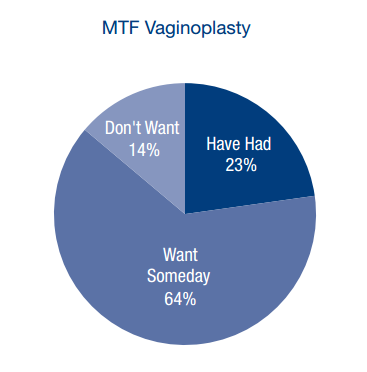
But whatever the reason, it's their decision because it's their gender. It's their choice of how to represent themselves in the ways that they suppose will win them the broadest correct interpretation of that gender. The physical changes are not so much for themselves personally and directly as they are for the broader culture that they live in to correctly interpret their gender, and to correctly understand their gender and engage with them appropriately for their gender in the context of their culture.
When I say that it's not specifically for themselves, I don't mean that it's not for them at all, because we internalize our culture. My ideas of what is feminine and what is beautiful are all determined by modern Western beauty standards, because that's what I've been surrounded by, that's what I've grown up with. I don't personally find body hair attractive. I've never found it attractive on anyone, of any gender. I'm going to great lengths to have most of my body hair permanently removed. I'm starting with my face, because that is one of the most common and visible culturally relevant gender markers.
A step I want to take beyond that, to have the leg hair permanently removed, for example, is a combination of my regard for bare, smooth legs as more feminine than not, and the fact that my skin tolerates all methods of hair removal very poorly. Shaving, depilatory creams, tweezing, sugaring, threading, and electrolysis. Waxing irritates my skin very badly, too. But only once a month. Only for a few days.
That's not just some arbitrary decision that I've made because I've just decided out of nowhere without any context that that expresses femininity. It's because my culture views that as a marker for femininity, and I've internalized that. So when I get it done permanently, and while I keep it up with waxing until then, I'm motivated by the culture that I've internalized, rather than truly by myself. It's so that when I look at myself, I see what I want our culture to see, so that it will understand me and interact with me in ways that are appropriate to my gender: as a more-feminine-than-not woman. Because that's who I am.
This past weekend, I went to my first Pride event, in Seattle. It was my first Pride event anywhere, my first Pride event of any kind. Kim (#girlfriend) was excited to take me, and I was excited to go with her. People kept asking me how many I'd been to, or if this was my first one, and I'd say, "this is my first one. When it was on last year, I didn't know any of it applied to me." Pride happens in June. I hadn't figured out that I was a girl until August. And while I had been supportive of LGBT concerns and problems, and fully on their side, I was also miserably depressed, and so the extent of my work as an ally was tabbing out of League every so often to Like a few pictures from the event.
When I went this year, my first time, something that really struck me was how completely on-alert everyone was to look out for each other. Everyone. I saw someone drop his phone, and I and maybe 15 people on either side of me in each direction shouted, "PHONE!!!" Before it hit the ground, this guy turned, and looked, and saw it land. He picked it up, and said "thanks!"
I saw a little girl running by the fountain slip and fall and cut her elbow and bang her head pretty good, and stand up and start crying. This guy in shorts, just shorts, near the fountain ran up to her and made sure she was steady on her feet. He had her direct him to her adult, and he stayed with her the whole way, telling them what had happened before taking off back to where he'd come from.
Early on during the event, during the parade portion, Kim and I were not feeling especially well, so we ducked away from the main parade route, and found somewhere to sit down and have some water and a bite to eat. We got out our phones and started scrolling through Facebook. One of the things that I saw was a post from Jamie, who had added me as a Facebook Friend when I'd first contacted her. It was a picture of Cameron.

And that devastating sense of loss that had connected me to Cameron, the same way it had connected me to Leelah Alcorn and Taylor Alesana, was brought into really sharp relief. Part of what was so crushingly sad about these girls' deaths to me personally was that I thought that something that might have really helped them would have been to see a trans woman like me. My age. To know that there's a life after high school for girls like us. To know that there are ways to survive for girls like us. And to know from firsthand experience that there are entire major cities that will love girls like us. And I started crying, right there on the spot.
My First Pride came very late in life, because I did not know who I was. Cameron's First Pride never came. Because he never had the chance to figure out who he was.
