Monday, August 10, 2015

Second Born

This post is NSFW. For like 17 reasons. First of all, there's some masturbation talk. No real details, mind you, but the word does get bandied about a bit. There is discussion of various kinds of pornography. There is also a video embed that has music which simply must be heard to fully appreciate the video. And on top of everything else, it's gonna take a good while to slog through it all. Just wait until you get home or are on the bus with your Beats on or something. It's probably best enjoyed with some soothing something, whether it's a nice cocktail, or a bit of weed, or even just some hot chamomile tea. So yeah. Get home, get relaxed, and let Aunt Sera tell you a story.


Before I continue, I want to make a few things crystal clear. In the course of this post, I describe some things, in contrast with certain aspects of my own personal, self-directed internalized cultural definition of femininity, as "wrong." I am speaking only about and for myself and my own experience. I am not and never will intentionally try to define anyone else's femininity, or any other gender expressive traits. Also please try to remember that there are as many trans experiences as there are trans people, and while there are probably many trans people who can process my experience as similar to their own, there are probably many more for whom my story does not really resonate.

My story is tied pretty deeply into sexuality as well as gender, and this is not necessarily always the case for trans people, broadly. I don't see how it even could be the case for trans people who figured out their gender very young, before they even had any concept of sex or sexuality. My story is also one of nothing happening for a very long time, and then everything happening kind of all at once, in very rapid succession, which is nearly unheard-of. If you want to get to know a trans person, approach them the way you would anyone else that you want to get to know. Please keep in mind that this is as much a journal or diary as it is a blog, for me. I'm just leaving it out on the living room table for you to read.

A year ago today, my friend Kat took me out to get my first pair of women's shoes. The topic of cross-dressing had come up, and we'd decided that it would be fun to both go out "in drag," and just interact with the world as genders opposite our own. It was to be part one of several of building my Girl Outfit, singular, because I had no real spare money, and Kat had some, but not a lot. It was supposed to be for something silly to do.

Prior to that, I'd had deep and intimate conversations with Eva, one of the very kindest girls I've ever met. We were talking a lot about sex, but not in a potential partners kind of way; it was more of a broad conversation, learning about the kinds of ranges of preferred activities we each had. I suspect most people are not as vanilla as they seem outwardly, and we were no different.

Among my confessions was the fact that as my depression deepened, itself in direct proportion to how long it had been since I'd had a romantic relationship, my tastes in pornography had started to slide. I had progressed from watching straight porn for straight guys to watching trans girl porn. I don't remember actively seeking this kind of content out, so I'm guessing that I stumbled upon some by accident, and then couldn't look away. But something felt wrong about the trans girls, to me, and looking back, I think it was their highly masculine behaviors in sex.

The first several of these that I saw included a trans girl with a cis guy, usually getting head from him, or something like that. This had its appeal, but it felt wrong for me, it felt off. But then I started finding the other kind of trans girl porn (and in my brief experience, it seemed like there were only two types). The other kind of trans girl porn has the trans girl in roles more like the cis girls in common straight porn for straight guys. I reacted powerfully to this, but the shocking part to me was that I realized that I was identifying with the girl in these sequences. That I had no interest in imagining or recreating what the guys were getting in these scenes. I wanted what the girls were getting.

Continuing my mostly-accidental pornographic exploration, I took a detour into gay male porn, and learned pretty quickly that guys doing guys didn't really do anything for me. It didn't gross me out or anything, I just couldn't identify with anyone in any of what I saw, which confused me at the time. It makes perfect sense, now; there weren't any girls. I didn't think to look for lesbian porn. I ended up back at straight porn for straight guys, and discovered, to my temporal dismay, that I just could not identify with the guys in these things at all anymore. Not only did I actively not want to in the first place, even if I tried to find arousal in identifying with the male point of view, I could not.

I don't know that I necessarily ever had, but since I'd definitely never considered possibly identifying with the girls, identifying with the guys was where I had always ended up by default. Without any real thought. It was reflective of my entire life to that point. Never really feeling manly or masculine, but, being told that I was male by everything external to myself, never considering that I might be female. Or at least not male.

When I talked to Eva about these kinds of things, often in the context of my trying to understand what she, as a girl, sought out and enjoyed and preferred in sex in order to compare it to what I found myself now compelled to seek out, she did the greatest service any friend can ever do any other friend when they are told something that that person feels extremely self-conscious about. That she did it instinctively is part of what leaves her in such high regard with me, especially given her age. Like many of my friends from Everett Community College, she was 19 at the time.

Eva said that what I was fantasizing about "isn't bad or weird or anything."


And that was enough. It left the door open a crack, and I stopped trying to force it to stay shut. So when Kat asked about cross-dressing, I was excited, but on a primal level. I felt like I was about to discover something fundamental to who I was, and I didn't know what was going to happen. But that was about as close to feeling alive as I'd been, to that point. Not knowing what was going to happen next, but being really heavily invested in the outcome of something for the first time in my life. Genuinely invested, not just pretending to be because it was what people wanted to see. I was along for the ride, because the ride was producing emotions. I was doing it because I finally stopped feeling so completely dead inside.

Or undead, perhaps. I'd felt stuck for decades. Sentient, but not alive. My actual greatest fear for as long as I could remember, even while I realized intellectually that it had to be irrational, was that I would never die. The sense of utter stagnation in my life, combined with my lack of apparent signs of aging, teamed up to create this scenario, and it didn't feel that unrealistic. That I would be stuck, emotionally around 14 or so, while physically 739, and looking like I was 25.

I'd tried on some women's clothes before, but I never had any reaction to it. By itself, it hadn't moved me. It had been a joke. "Hey, Kat, I bet I can fit in your pants!" And she'd say, "let's see," and I'd try them on, parade around up and down the hall in mock-feminine runway model fashion, and we'd all have a laugh and maybe snap a few pics before moving on with life. I tried on one girlfriend's dress, and could not get my head around how she managed to pull it on, since she had pretty substantial breasts, and I had none to speak of, and it took me a good deal of time and effort to get into it. But I did, eventually, squeeze my way into the dress, and my friend Josh, a photographer, gave me posing directions while we got some shots. And again, it felt, at the time, like a send-up of modeling, like a funny game. It didn't actually trigger any deeper thought.

But then, I had been in a different place in my head at the time. With a girlfriend, my need for a constant feminine presence in my life was met. My distress at its absence was soothed. My focus was elsewhere. I remained depressed, but not quite as sharply. I turned my energies to acting (and now realize that part of my love for acting was that I could become someone other than who I assumed I was, back then). If I had spare time, I would hide in online games, role-playing the women I'd invented and whose lives I now know I'd wished I'd been living. I did play some other kinds of games, but really, most of it was massively multiplayer online role-playing games, like The Lord of the Rings Online, Champions Online, and Star Trek Online. I'd managed to avoid reality so thoroughly that I was not even aware of why I was really doing it.

Kat and I ended up at the Alderwood Mall J.C. Penney's, and she found me a pair of wedges by 9 & Co. She found herself a pair of Chucks, and was disappointed that the men's sizes didn't go down small enough to fit her. I pointed out that they were really the same exact shoe, so a plain one in a women's size would be the same as an off-the-scale small one in a men's size. She was still mildly dissatisfied.

When I first tried on the wedges in the store, I liked the way I felt. A lot. But I felt embarrassed, too. Intensely embarrassed. I imagined eyes and judgments on me that were probably not there. Kat bought our shoes, and we left. On the way home, I was so excited I could hardly stand it, but I wasn't sure what I was excited about. I was giddy, and I felt like that was supposed to mean I was happy, but I was so nervous at the same time, so scared, that I couldn't tell what I was really feeling. I couldn't tell what the primary emotion was. I was being flooded with them. This, after literal decades of not feeling a thing.

I remember laughing and telling Kat I was excited, and that I'd never in my life given a shit about a pair of shoes before, so it was a strange sensation for me.

After she'd dropped me off, I was alone at home for awhile. I tried on the shoes for real, not just for a few seconds in a department store. There I was, with hairy legs that had never known a razor, in my wedges, my brow furrowed, trying to figure out what was wrong with the picture. I decided I needed to shave my legs.

It was late summer by then, and I am constantly more cold than hot, so I figured nobody would ever see unless I wanted them to, since I was basically always in pants. Usually jeans. I thanked Costco that I had a gigantic pile of disposable razors, grabbed one, and headed for the shower.

I took my Gillette Men's Shave Gel (for Sensitive Skin) and slathered it all over my legs from about the knee down, and set in with the razor. I had no idea what I was doing, really. I was accustomed to shaving my face, and being able to see everything I was doing. I didn't consider this problem until my legs were already partially shaved in the shower. Even then, I probably didn't really consider it, because my brain felt like it was trying to process the discovery and knowledge of every beautiful thing that exists in the entire universe all at once, in every moment.

With the first stroke of that razor across my leg, I finally had my first glimpse of the depth of my own femininity. It was overwhelming, complete, and absolute. I felt beautiful and powerful for the first time in my life, and with those came the sense of feeling entirely female, and that feeling true and right. It flipped every switch in my head that had anything to do with gender, and it flipped them all at once. All of them. At the same time.

I became very powerfully sexually aroused, but I noticed that while I was feeling more erotically alive than I ever had even come close to feeling in my life, I had no erectile response. None. At all. And while a guy would've probably found that incredibly distressing, it filled me instead with joy. I could not describe it. I still can't, really. Ineffable happiness. I was giddy with it. But at the same time, I was so impossibly turned on that I was sure I was going to get back to the relative privacy of my bedroom, and masturbate more furiously than I ever had in my entire life.

When I got back to my room, I took my little naked self over to my bed, and sat down. I started smoothing lotion over my legs. I'd shaved basically my entire lower half. The expectation of sexually touching myself faded away as the desire to actually do it never materialized. I was left with this warmth that penetrated and radiated from the core of my being, still more deeply sexually aroused than I'd ever been, and still without the slightest reaction from my penis. It was vaguely similar to an afterglow, but vastly more powerful and expansive, and without any orgasm prior. And unlike an afterglow, it would not go away.

Lacking any proper panties, I pulled on a pair of spandex bike shorts I had left over from when I'd been in the Army. Then I put on the wedges and admired myself. Well. My legs, anyway. I took a few pictures, and I felt a rush of joy that was quickly followed by a rush of shame. I recognize this now as the death throes of the faux-masculine construct I'd been unwittingly hiding in for my entire life, but at the time, it was alien and terrifying.

But I knew I could share these pictures with Kat and Eva, at least, and they were, as you might have guessed, completely supportive. They asked gently probing questions, but they let me lead the discussion; they let me explore, while helping me feel safe and, above all else, not weird or awful. It is in no small part due to how they treated me that I do everything I can to give questioning people who come to me wondering whether they're trans the same kind of safe interpersonal space to figure it all out.

I spent the next two days in what felt like a nonstop and very intense full-sensory montage. I can't remember anything about that time. I know I was in classes at The Art Institute of Seattle, but all I really knew was that everything in my entire life that had always felt ineffably wrong, that had never made sense, now made perfect sense.

The ways that I described depression, for example. I would say things like, "I feel like an alien who's come to visit Earth, started wandering around a bit, and then forgot where he parked and now is just stuck here." Or, even better, "I feel like an ocean creature who lives and dies and spends his entire life in water, but on the surface, and can only see the sky." I had thought I was trying to talk about a sense of isolation, but I was wrong. I was trying to talk about knowing I was in the world, but feeling apart from it because some central lens crucial to understanding my life was missing. Or more accurately, factory-sealed with a lens cap on.

I looked at old songs I'd written, and wondered how in the hell I could not have known with easy certainty that I was a girl. That I always had been. How in the hell I could have ever framed the thought in my head as "I wish I was a girl," and not "I'm probably actually a girl." I know, now, that the biggest reason was that actual data on actual trans people just was not widely available for most of my life. I had the same reference points as nearly everyone else in the world; porn, and movies like The Silence of the Lambs.

I've never done porn, and I can't sew, so neither of these has any relevance to me. Caitlyn Jenner, while highly visible, has a very rare set of circumstances for anyone at all, never mind a trans woman. My net worth is probably negative, while hers is estimated to be around $100 million. Not much relevance to me there, either. Nor, I suspect, are any of those very relevant to most trans people. Although I'm sure many of us can sew quite well.

A large part of why I am now working to be as highly visible as possible with every boring detail of my life is to let everyone in the world see what my life is like as an actual trans woman. Not a sex object, or a terrifying character with alien desires and a penchant for murder and human skin footie pajamas. And a dog. Not the "I kissed a man!" girl-who-is-actually-a-guy of The Crying Game and/or Ace Ventura: Pet Detective. Just another actual girl doing any-other-actual-girl things; laughing with friends, petting cats, going out to eat, staying in to cook, visiting a park, playing Cards Against Humanity, giving the neighbor horse some food, or just singing to herself while driving. Living.

I envy your successes
Your pretty face
I envy you your gender
Your empty space
'Cause mine isn't so simple
It's not supposed to be
People tell me what I've got
Inside me
But I'll be young forever
And I'll fail when I can

It was as if I knew it all when I wrote those lyrics in 2002. And yet I didn't. I wouldn't figure it out for more than another decade. And when I did, it felt like I'd been working on a massive mathematical proof for my entire life, knowing that it was getting further and further from where it should have been going, but not knowing why; and then seeing something that reminded me of the fundamental structure of the proof, and going back to check it, and realizing that I'd added 39 when I was supposed to raise to the 39th power. I watched decades of nonsense fall into place and click and fit like it had been designed to all along.

My guards on every little thing, even my mannerisms, all fell away. I'd never moved or acted in a particularly masculine way, but I'd gone out of my way to mask my natural movements, I realized. And when I moved in ways that felt natural and right to me, not restrained or imagined, I felt at home in my own skin. I felt how simple and joyful life could be. How ordinary and wonderful.

My eating habits changed of their own accord. I immediately went from my old style of not eating until I was ravenous, then gorging myself until I couldn't move, getting awful heartburn, and repeating ad infinitum to noticing when I was hungry, and then eating something light, usually a salad, until I felt no-longer-hungry, rather than full. I didn't even realize I was doing that until a couple weeks had gone by.

The depression that had defined my entire world for as long as I could remember vanished. It lifted like a morning fog in the sunlight. I had such incredible clarity. I could see everything. I could see eternity. I could see the ineffable. And it was beautiful.

I started telling more friends, starting with the closest. I tried to reach out to my friend Brandy, from The Art Institute, about it. But I was still very scared of judgment and rejection, and when Brandy, having no idea what I was on about, told me she'd definitely make fun of me if I showed her the first shoes I'd ever been excited about in my life, I balked. I thought she was probably just joking around with me (she was), but I couldn't risk it at the time.


Shortly before I realized I was a girl, I just started swapping people's genders for my own amusement. I decided that everyone needed a boy name and a girl name. I decided mine was Sarah, which was odd, because I'd never been particularly enamored of it. But it felt like my name. I think even then, when I was, I thought, playing a silly game that meant nothing, I was just about ready to shed my skin, and I really was just that clueless about it. (Remember this if we end up being close friends, and you are boggled by my intelligence coupled with my absolute inability to understand some few select things that seem really basic and fundamental to you.)

Brandy, I had decided, needed a name that was almost elegant, but also somewhat brutish. I settled on Helmut, which she protested but played along with. She was one of the last people I actually told individually after I'd figured out I was a girl. But she was the first person to call me Sera in public spaces like our school, and it thrilled me even though I thought that was just because people were playing my stupid game. She would shout down the hall to me, "Sarah!" and I'd hear my name, and smile and turn to see what she wanted.

In our chats, I would sometimes initiate the game state by addressing her as Helmut, or, affectionately, mumu. And she would play along. I was a girl, and she was a guy. We'd use the right pronouns for that being the case. Even though it was still just a game to her at the time, it was so incredibly valuable to me to have those kinds of interactions. Because the characters we were playing were still us. We just had different names and genders than what people would have expected if they saw us. And it was fine.

Around the time I was having that chat with Brandy, another of my close friends whom I'd come out to said that she was pretty sure the VA covered GRS for veterans. I did a bit of research, and learned that there was coverage for HRT and mental health, but nothing else trans-specific at that time. I called the VA Puget Sound Medical Center. They told me to just come into the ER to be seen, and after I'd been assured that that was protocol even for non-emergent care, I went down that Friday, my day off of school, four days after I'd first been struck by the realization that I might possibly have misunderstood my gender for my entire life.

I chatted with a social worker who interviewed me for about an hour. Well before our time was up, though, she seemed less interested in the whether-or-not of my gender, and more curious about how I was processing it all. I did not have to work to convince her of the truth of what I was saying. It was apparent in how overwhelmingly joyful I was, contrasted with my very vivid and matter-of-fact discussion of just how bad my depression had been, at its worst. I was referred to see a clinical psychologist in the Mental Health Primary Care clinic, scheduled for August 29, 2014.

My girl friends were all very excited for me, and I soon found myself buried in clothes that I could hardly understand, along with so much makeup that I still haven't gotten around to experimenting with all of it. Chandra had given me several paper Target bags full of clothes, including some underwear. Of all those, a single set of three panties fit me, and I could not find more until I went with her to Aerie the following spring.

Kat came over and started helping me sort through it all. She would have me try things on, and help me to understand what was fitting the way it was supposed to, and what was not. I was happy to see her take the few things that fit her, but not me. She pushed me gently, offering to do my hair and maybe some makeup, so we could take pictures along the way and capture the moment. You know, in case I ever started a blog or anything.

What you see here is a girl who is 39 years old and has just found out she has actually been a girl her whole life, and not a guy, as she'd always just assumed. This expression is the face of absolute joy with shades of absolute uncertainty, and Kat read it perfectly. There was nothing too intimate or embarrassing for her to help me understand, and she patiently helped me build my first few outfits, while easily and unabashedly dipping into quick tutorials on things like how to properly roll a sock for the most natural looking bra stuffer possible. For a sock.

I started throwing names about, but I kept coming back to Sarah. I thought of all the great puns and pop culture references I could make with the freedom to create any name I liked. I toyed with an old X-Men reference, I built names to give me saucy initials, I could've used a throwaway gag from Family Guy, all sorts of fun. But still, for a first name, I was almost immediately settled into what I would've spelled at the time as "Sarah." I bounced some ideas off of my friend Dan from Class Voice at Everett Community College.


By midnight, with Dan's encouragement to be really completely true to myself with my new name, I had settled into Seranine Elisabeth Elliot. I vowed to keep it a secret from just about everybody until I'd had it legally changed. But the decision was made, just nine days after I'd first suspected that I was a girl in the first place. The very next day, I reached out to my older brother and his wife, and found resounding acceptance. He said, "I'm glad you told us- we're both happy for you. It's great that you can find what you need to be happy!"

As my psych appointment to hopefully get diagnosed with Gender Dysphoria neared, I vacillated between certainty that I'd get the diagnosis required to start any kind of transition care, and certainty that I wouldn't be diagnosed, that I'd be laughed out of the clinic, that I'd have an enormous struggle before me to even be acknowledged as who I was. I poured all of this worry into trying to put together an outfit.

I went with a little black dress I'd gotten from Hailee, along with my wedges, still my only women's shoes at the time, and one of my old men's button-down shirts, a red silk blend that someone had suggested I tie off near the line of my ribcage. For a good while after, this was the only outfit in which I'd feel truly confident in the expression of my femininity. I'd done the best I could on my makeup, and it seemed to work well enough. Even at the VA hospital, which I would guess is among the more conservative spaces that close to Seattle, I got no ill treatment from anyone, just a bit of staring once I'd gotten to the actual clinic.

I suppose I may have been bursting with such nervous energy that my high-powered grin disarmed people before they could register the comparative oddity of what they were seeing. Or maybe enough of the people around me that day lived in or close enough to Seattle that they just weren't shocked. I remember a few uncomfortable lingering stares while I was actually waiting to be called in, but even these people at least knew well enough to not say anything.

I'm sure I spoke very quickly when I actually got in to see Dr. Santerre. He was an excellent listener, which was par for the course with my experience in seeing DoD psychologists. He largely let me take the lead and just talk, only asking for a clarification now and again, and, towards the end, making sure he had a qualifying factor for each criterion. I remained on the edge of my seat because his demeanor was so serene that I could not tell whether he found my story absurd and boring, or so straightforward that I was more or less doing his job for him.

"Well," he said, "this seems pretty cut-and-dry. Let's get these documents squared away before we run out of time." He filled out the first form, my WA DOT gender marker change form, but had to refer me to my primary care doctor for the other one, a form letter for changing gender marker in most other arenas (such as the VA itself, and the Social Security Administration).

Though it took a few weeks to hear back, I was soon scheduled to see endocrinology to start HRT. I had been assured that, barring any sort of rare blood disorder, I would almost certainly start with a prescription on my first appointment with them. It was scheduled for October 24, 2014.

Other things happened more immediately. I was ecstatic, and the first person I thought to call was Jenn. After six increasingly-difficult years together, we'd finally separated, and we had both been in such pain over it that our common wish to remain friends was constantly strained, and often felt as though one or both of us might abandon it entirely. We had agreed that if nothing else, she would always be welcome to visit with my kids, whom she'd helped raise during almost every visit I had with them after separating from their mother.

Our last several conversations had been strained, even though we'd gotten better about avoiding anything really touchy. Her new boyfriend did not like me one bit, even insisting that he come along when I managed to convince Jenn to come help me pill all the cats to worm them because he was convinced that "help me worm my cats" was some kind of sex code. This was why I later decided not to offer her my rice cooker.

A photo posted by Seranine Elliot (@aggressivefrontpocket) on

When she answered the phone, I stumbled around for a few seconds with "uhhhh, I don't know how to say this, exactly," and such. But before long, I'd blurted out that I was just now coming from my appointment with the VA Mental Health Primary Care clinic, and had been formally diagnosed with Gender Dysphoria.

Jenn immediately congratulated me on this discovery, saying that I sounded happier than she'd ever heard me in her life. She asked to hear the story, so I told her an extremely condensed version of it. A version you're probably wishing I'd written right now, instead of all this. Her first two questions were, "do you have pepper spray?" which confused me at the time, and "did you seriously have no idea?" to which I replied, "no... wait, what?"

She pointed out that one of the first things I'd done when I moved out to Washington to be with her was try one of her dresses on, and she seemed skeptical when I poo-pooed that. But even so, she was immediately very supportive, and, like my evaporated depression, everything awful between us seemed to disappear. We sometimes still apologize to each other, and the response is pretty much always the same. "It's okay." She has since become probably my very closest ally and supporter, and I am just speechless with gratitude.

I went to the courthouse in Arlington straightaway, and scheduled a hearing date for my legal name change. It was set for September 3, 2014. I went home, and made a post on my personal Facebook page, in the form of a light-hearted FAQ.

After a weekend that included my first girly haircut ever, I went to my morning courthouse appearance with MJ, who got up very early to drive up to Arlington from Everett just to do my makeup and come with me. Countless gestures like this from all the girls I knew were just filling me to bursting with gratitude. At the courthouse, nobody really gave me a second look, which was a great relief. I was told to wait in the actual courtroom, and was the first order of business, as I'd been told I might be. Name changes are typically rubber-stamp affairs, so after a few basic and kind of absurd questions, the order was given, and I was sent back outside to wait for my certified copy. MJ and I were on our way back to the house by 9 A.M.


Although I'd started going to school wearing panties and a camisole under my "guy clothes" almost immediately once I suspected I might actually be a girl, by September 10, 2014, one month to the day from the start of my revelation, I was out full-time. I had left the house one last time dressed out-of-type, just the day before. That was the very last time I ever dressed or carried myself as outwardly masculine, and setting down that burden was one of the greatest reliefs of my life.

In the year since I discovered who I've really been all along, I have changed so much. I've changed in the way a flower blooms. And with the beauty of my personal truth becoming plain to everyone around me, along with the joy I am very often overflowing with, incredible things have gone my way.

I've made new friends and reconnected with old ones, including my first wife, whom I'd not been in contact with for nearly 15 years. I made amends with one friend from my L.A. tech days over damage I had not realized I'd done. I made friends with a parent of a trans kid who'd committed suicide, and we have expressed such gratitude to each other over this relationship. I've been interviewed three times for videos that were not mine, I've been an extra in my friend's digital short, I've been paid to model, I've been asked to speak before classes, I've been invited to join some incredible local musicians onstage (during a Third Eye Blind tribute show at the Royal Room), I've been extended permanent discounts at some Seattle stores, had food and weed and easy conversation all bestowed freely upon me, just for being so completely and unashamedly myself that people usually feel happier than not around me.


If all of that wasn't enough, I met an absolutely amazing woman who has become a tremendously positive force in my life in just the three short months since we met. I've yet to write my own posts dedicated to Kim, but they shall surely come. And the reason I met her was a confluence of wills; she had decided she would deliberately seek out trans women, after being so deeply and viscerally struck by Leelah Alcorn's suicide, after being primally disgusted with how awfully she had heard we were usually treated in the dating scene, and I had decided, the day we met in person for the first time (just a day after our first interaction ever, and without knowing when or whether we'd chat again, never mind actually meet), that I was going to just kill the afternoon bumming around Seattle. I was going to stay out, instead of just going home and playing video games and hoping I would die whenever I had a free moment to consider anything but the game, the way I'd always done before, when I was through with my errands. I decided I was going to stay out and drive around and sing and be happy. And be seen being happy. I went all over the city, taking selfies by various minor landmarks and in front of some of my favorite businesses.

And because of this conflux, I was still sitting around in Seattle, just gazing out with a smile at Green Lake from my car, when I got a message from her asking if I'd like to play pinball with her soon. It was a beautiful day, because I had decided it would be. And it all made perfect, joyous sense. Of course it did. How could it not? I'd finally been born.

Monday, July 20, 2015

Stop Me

Oh-ho-ho stop me
Stop me if you think that you've
heard this one before

"What's Victoria's Secret?" he asked.

Nobody answered.

"She used to be Victor!"

I heard this joke this morning in my Design class. It was very upsetting right off the bat, and I found myself reacting, instead of, as I prefer, responding.

As the collective groans went up, I said, over the top of them, "oh, wow, great, transgender jokes. Hilarious." The room went dead silent. We locked eyes, the student who told the joke and me. He started to stammer.

"Oh, I didn't mean anything offensive by it," he managed to spit out.

"Yeah, but it was offensive. It's really gross, actually."

"Okay, but I didn't mean to offend anyone with —"

"Usually, when people offend someone else, they will —"

"I apologize."

"Thank you."


Class resumed. We had assignments due this morning, so we had all put our projects up on the back wall and were preparing to talk about lines and continuity and contrast and emphasis. When the instructor handed me a jack-o-lantern bucket to put my grading sheet in, I didn't understand that I was supposed to fold my paper into quarters, and then also pass the bucket around.

"I'm sorry," I said to the teacher, after he'd explained it directly to me a second time. "I'm a bit distracted."

"Yeah," he lamented. "Sorry about that."

"Oh, I'll be fine," I answered, passing the bucket along.

"This is how we can tell you never went to church," my friend Erica quipped, trying to cheer me up.

"Is that the giveaway?" I smiled back at her.

Critiques went on, but I kept mulling over this problem in my head. I knew the joke was offensive, and even the guy who told it knew. He'd let it slip before considering the audience. I've done that millions of times. I have a lot of room to forgive that construct on its own merits, because I know it so well. I also usually have a lot of room to forgive ignorance. After all, a year ago, I might've made the same joke, because I had the same ignorance. (Remind me to tell you some time about how my Ok Cupid dating profile, right up until I realized I was a girl and shut it down, contained the term "she-male.")

I'm sure that the guy who told the joke thought it was a harmless play on names. And many trans women do adapt their birth names into a feminine form. In a space like this, where I felt empowered to speak up because we were at a school with "Safe Zone" and "Trans Safe Space" stickers everywhere, where I felt like there was institutional readiness to defend me, where I was not afraid of repercussions, I was able to challenge the joke. But I wasn't able to quite explain why it was offensive, only that it was. And that's what made it a reaction and not a response.

I had more reactive thoughts, but I was able to recognize them for what they were pretty quickly, and, after biting this guy's face off, I was able to reject these thoughts, to refuse to act on them. I'd remembered how, for example, at The Art Institute of Seattle, I was told to go directly to the Dean of Student Affairs if anyone gave me any abuse for being trans, because the school had a zero-tolerance policy on that kind of behavior. Which means that, had this been a class there, I would've been within my rights to have this guy removed from the program, removed from the school entirely, for not realizing that the joke he was about to tell was offensive before he told it, and then not ever actually telling it.

And I feel like that's a bit extreme. It's like when we have a passenger plane shot down by an RPG in the Middle East, and three Americans and a Canadian die, so we send in The Whole Fucking Army and bomb the shit out of the village the RPG was fired from, and then install a new mayor there, bring our soldiers home, and promptly ignore their PTSD and missing limbs. It's not an appropriate, proportional response. It's a reaction, a gross overreaction, and it makes everything so, so, so much worse. While critiques were in progress, I sussed this all out. And now, I have my response.

This joke isn't just offensive because it mocks and then erases Victoria's own narrative, whatever it may be. It's offensive because it gets people killed.

This same joke, told in a different setting, say, a bar, about a woman who is actually at the bar, can also be meant to be harmless and inoffensive. Maybe the one telling it has the sense that it's cruel on some level, so they make sure that the woman at the bar can't hear. Maybe someone who does hear it is a drunk guy who had been trying to work up the courage to go ask her if she comes here often.

Now, while his judgment is impaired, he is challenged with things he was not prepared to be challenged with. "If she 'used to be Victor,' then she was born a man!" he might think. "Does this make me gay?" he might think, which is usually not happily followed with, "oooo, I should figure that out for myself," but rather, "I'm no faggot." With fear and loathing. "Maybe instead of one of us, I'm... one of them."

Maybe Victoria only feels the mood in the bar shift out of her favor. Maybe she only notices that all the friendly, interested glances have turned to confused and angry ones. Maybe someone blocks her way when she tries to go to the bathroom, and insists she use the "right one," the men's room, instead. Maybe she ends up not going to the bathroom at all. Maybe she goes home, safe on the outside, and kills herself. Or maybe she's dragged into the men's room and forced to go. Or maybe she gets beaten up. Maybe she gets raped. Maybe she gets murdered.

That's a lot of maybes. But not the imaginary maybes of trans-women-are-men-who-want-to-attack-our-daughters-in-bathrooms. It's the maybes that are very plausible backstory to the kinds of killings that keep on happening. Whether some guy at the bar actually destroys Victoria, or whether she learns to hate herself so thoroughly that, in the end, she destroys herself, these jokes, these mock narratives, are often key elements of the setting. Sometimes they move from the background to the foreground, and become catalysts.


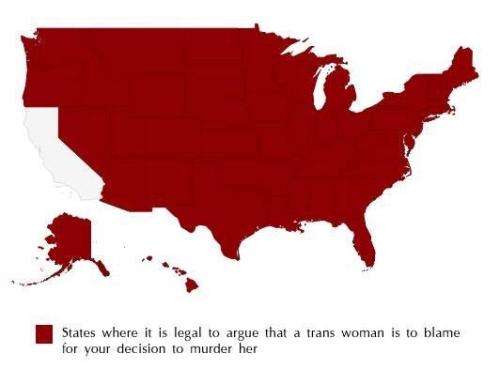
And if that happened in any state but California, the murderer's defense attorney would be able to legally argue in a court of law that Victoria was to blame for her own murder. That the defendant was "so shocked to learn that their victim was gay or trans that they had no other recourse besides violence." That Victoria shouldn't have been out in public as herself. That because she didn't hide who she was, she was more or less asking for it.

Who said I lied, because I never, I never
Who said I lied, because I never

When critiques ended, we were put on a short break. I went up to the guy who'd told the joke in the first place, and gave him one of my cards.

Nothing's changed
I still love you, oh I still love you 

A photo posted by Seranine Elliot (@aggressivefrontpocket) on

"I hope you know, I don't have any prejudice against anyone," he said. His body language said he didn't want my card. That he didn't need it because he didn't hate anyone.

Only slightly, only slightly less
Than I used to 

"Yeah, but we sometimes still say shitty things because we don't understand. I'm inviting you to get to know me," I said. "I blog about stuff like what happened in here earlier," I continued, as he took the card grudgingly. "Because I think it's important. I'm going to write about it soon."

And now I have.

Thursday, July 16, 2015

Syntax Error

In computer programming, one type of problem we run into is the "syntax error," which, as the name suggests, is an error of language. You may have, in your mind, the perfect programmatically logical solution, very clean and elegant, but if you don't put it into the exact terms that the compiler requires in order to understand what you are trying to say, it will fail to process. It may even process in unexpected ways, leading to actions you never could have predicted. But usually, it just stops completely.

This has become analogous to how my interactions about being trans have been with some people who are religious. I knew from the start that a scientific or statistical argument would never resonate with a religious person, because their religion is the lens through which they see reality. A Woman of Science would not accept biblical arguments as valid, in the same way that many a Man of God chooses his own interpretation of his religion over any empirical argument.

What I have to communicate is not unclear. The way in which it has to be presented in order to be deciphered correctly is what eludes me.

The most common thing I've heard from Western religion is that capital-G God commands us to love one another above all else. I'm on board with that. I've written elsewhere about my realization that I actually love everyone. The idea of a synthetic social control mandating that everyone who subscribes to it must love everyone else in the universe doesn't really upset me. I think it's a basically good thing that would lead to basically good actions.

Where we may differ is on the definition of love (as a sentiment one has for others). I describe it as "desiring health, safety, and happiness for someone." I'd love for someone to offer me the Christian definition of love, because I am only able to argue from a position of ignorance about the other side's definition, but I can't help but imagine that it's essentially the same. The core of it, the simplest form, is probably identical or nearly so.

I was walking, today, through what I suppose I'd call the quad at Everett Community College, and I passed a trio of what I colloquially (and I hope inoffensively) think of as "Jesus People." I paused and turned back because I thought I recognized one of them from before. Like, Before, before. She was talking to someone else, offering encouraging superlatives and generally trying to be pleasant and supportive of a stranger. This made me smile.

A photo posted by Seranine Elliot (@aggressivefrontpocket) on

When the person she'd been talking to walked away, I said, "I think I knew you from here before..." and she said, "right, from acting or something? We hung out with Zorana," and I said, "yeah! That was it." We chatted for a moment, and I offered her one of my cards. She asked, "what was your name before, again?" and I answered, "it was Jason."

"RIGHT," she said, "I knew it was like Jason or Jacob or something." I said it was good to see her again, and said she was welcome to chat with me via my Facebook link from the card. I started to leave.

And then, she asked if I minded if she prayed for me.

I said I'd feel sort of selfish accepting a prayer when I'm really not doing too badly, in the grand scheme of things. She expressed that offering prayers, the process of it, was a gift to her, so it wouldn't be selfish for me to accept one. That made me smile, too, and I said, "I do need to find a job." So, she ran with that.

It started plainly enough, with phrases like, "Lord, I just thank you for bringing us here together today," and such. But eventually she hit a point where she had to use my pronouns, and she said "him." She seemed to have a little cognitive dissonance about it, which is appropriate, I think. I let it go and waited for the next one. "His." "Jason."

"That's not my name," I said, interrupting her prayer. "And it's 'she,' 'her,' and 'hers,' not 'he,' or 'him,' or 'his.'"

"But that's not how I know you," she said.

"But that's not who I ever was," I replied. "My name is Seranine."

"Who you were is who God made you," she answered, or something to that effect.

"If I was created by God, then I was made with a woman's brain in a man's body, and if that can't be a mistake, then it was done with a purpose." I spoke quietly, but firmly.

I declined the rest of her prayer, and moved away with a wistful smile. I was happy because she was out there, making her occupation loving others as honestly and completely as she knew how. And I was sad because that love came with conditions.

Surely if there is a God who is capable of all things and is infallible, They can love everyone everywhere without conditions. Even I can do that.

"I love you," she called out.

"I know," I said. "I love you, too."

The good news was that I am sure we both meant it. We both meant it with our own definitions of "love." That's a good start.

Monday, July 13, 2015

21 Things Not to Say to a Trans Person

I found this on my Facebook somewhere. I'm going to actually answer them all right now:

1. "When Did You Decide to Switch Genders?"
I never switched. Therefore, I never decided.

What a person asking this question is usually trying to ask is when someone realized they were not the gender they'd been designated at birth, and/or when they acted on that realization by beginning physiological transition processes. I first began to realize that I'd been incorrectly designated male at birth (DMAB) on August 10, 2014. I began transition more or less immediately.

2. "What's Your Real Name?"
Seranine Elliot. I had it legally changed on September 3, 2014. The "nine" part sounds like the number. Most people just call me "Sera," which basically sounds the same as "Sara" or "Sarah." The full name rhymes with "Caroline" with a schwa for the "o," including stress and inflection.

Keep in mind that a legal name change is not free. Many trans people choose a new name for themselves, but do not necessarily have the resources to get it legally changed at the same time. Many trans people are also reluctant to release their previous name, because it is usually used to harass, abuse, and/or disrespect them.

3. "Can I See a Picture of You Before You Transitioned?"
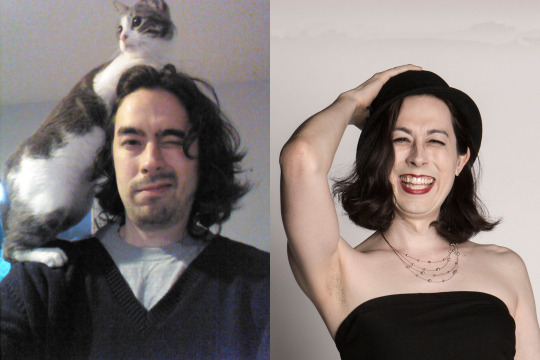
Sure, here's a whole pile of them. Pre-transition and/or pre-realization pictures show trans people under duress. A picture of someone who is not able to be their authentic self can be painful to even think about, let alone share. I publish mine because I want to shed light on my own process, so cis people can see for themselves how ordinary it all is, how human, and so trans people can see that it can be done, even for someone who didn't realize she'd always been a girl until she was almost 40.


4. "I'm Impressed - You Look Just Like a REAL Woman!"
This is meant to be complimentary, generally, but it necessarily implies that trans women are not actual women, which is false. I haven't personally heard this one to my face, yet, but I imagine that I'd probably reply with a thank-you, followed immediately by an explanation of why that's considered an unkind thing to say to a trans woman.

5. "Have You Had the Operation Yet?"
I suspect that most of the people who ask this sort of question are so overwhelmed by their curiosity about something they are usually completely unfamiliar with that they forget they are asking these questions of another human being. And human beings, broadly speaking, do not enjoy talking details about their genitals with most other human beings.

Fortunately, I am a cat.

I have not had Genital Reconstructive Surgery (GRS) or an orchiectomy (removal of the testes). (UPDATE: I had my orchiectomy on January 22, 2016.) If you really care to know when I have either, the best way to find out, honestly, would be to follow my social media. I'd go with my Facebook Public Figure Page, if I were you, but if you don't care about a by-the-minute level of detail, and just want to read a nice summary of it all whenever I get to writing about it, following this blog will do.

6. "Can You Still Have Orgasms?"
Much like #5 above, this is generally not good acquaintance-conversation fodder. The general rule is that if you wouldn't ask it of anybody else, you should probably not ask it of a trans person, either.

I am, in most arenas, an exception, because I have publicly and repeatedly said that I welcome questions as long as they are civil and respectful. My short answer to this question is, "yes." My long answer is probably another entire blog post, at least.

7. "Do You Take Hormones?"
Like most medical issues, this is usually considered private and personal. I am, again, an exception, because I am deliberately sharing my progress with as wide an audience as possible.

A photo posted by Seranine Elliot (@aggressivefrontpocket) on

My specific drugs, doses, and changes to either are usually not too hard to find. I tend to post about them on my Instagram, and share those posts to my Facebook Page. Right now, my Hormone Replacement Therapy (HRT) regimen is 2mg estradiol, 200mg spironolactone, and 5mg medroxyprogesterone daily.

8. "Wow, I Actually Find You Kind of Attractive - Great Job!"
I've actually heard this one, or some variant of it, a few times. Like #4, it's meant to be complimentary, but it's not hard to see why it isn't. It's objectifying, for starters, and it also makes a pretty bold assumption about someone's motivations for presenting themselves in whatever way. Whenever I've dressed up and put on makeup, which is most of the time when I leave the house, I've literally never done it with the intent of pleasing anyone else in any way. I do it primarily because it feels right.

It also says that you believe that the trans person you are saying this to is not normally seen as attractive by anyone, so they should be happy to hear that you, at least, find them somewhat attractive, so their future will not be as loveless and bleak as you had imagined it would otherwise be. This is kind of a horrible sentiment to share with anyone, for any reason. Even if someone is conventionally "unattractive," pointing that out to them in this kind of backhanded manner is as cruel as any other way of pointing it out. Chances are, they know how they are seen by society at large.

For myself, yes, there is definitely an element of trying to present to the culture, but since I'm a trans ambassador, I worry less about maintaining that presentation than I imagine most trans women do. I'm also fortunate enough to be slim and have relatively little body hair, on a body that was kind of androgynous to begin with, and is also white enough to be treated as capital-W White. Which means people more readily accept me as a woman, all other things being equal, than a trans woman who is comparably dressed, but darker, or with more body hair, or broader shoulders.

9. "Is It Okay to Still Call You 'He'? Sorry - It's Just Confusing!"
(I adapted this question to me; their version shows a presumably trans man to support the text.)

It's not okay to call me "he," because my gender is not male. I appreciate how it could be confusing for people who were around me before I knew who I was; until August of 2014, I'd never directly questioned the gender I was designated, either, so we all just moved along acting as though I was a guy. If I'd been called "she" then, or some other female pronoun, I would've been upset. That's because people tend to not like being called a gender other than the one they think they are. (Which is not necessarily the one they actually are, and yes, I realize that that opens the door to the idea that a trans person only thinks they are a gender other than the one they were designated at birth. But I basically used to think I was male, whereas I now know that I'm female. I've done the work in challenging and examining my own gender, so I'm no longer operating on an assumption. I'm dealing with an absolute truth.)

If you are a cis male, imagine that everyone, everywhere called you "ma'am," or "miss," and referred to you with she/her/hers, instead of he/him/his. As someone who knows himself to be male, and who understands that to be an absolutely true part of your core identity, that would be immediately distressing. It would feel frustrating and degrading, and if you had no way to get most people, most of the time, to gender you correctly, it could even feel overwhelmingly hopeless. And all of that is the very common trans person's experience.

Some people honestly do not know trans people's pronouns, and are visibly agitated while they try to figure them out. I suggest simply asking someone what their pronouns are. Not what they prefer, but what they are. Just like your pronouns, they are simple fact, not preference. Once they've told you what their pronouns are, do your best to respect them, and apologize if you fuck them up. If you do those things genuinely, it will be enough.

10. "What Does Sex Feel Like for You?"
Just like #6, there is a short answer ("fucking amazing"), and a long answer which is far too complex to dump into a survey-level post like this. It would also require co-authoring, or at least getting an okay to talk about some experience(s) in detail, which is, again, way too much for this particular post.

Rest assured that I am not personally shy about talking about sex and my own sexuality. However, I do want to be respectful to past and present partners, and I am also determined to present a balanced picture of who I am as an entire person, so I am reluctant to focus too intently on these topics before I've delved into plenty of other things that are only related by being parts of me. That is, you will probably see a post about my return to World of Warcraft long before you see the post about what sex feels like for me.

11. "Wait - If I'm Attracted to You, Am I Still Straight?"
If you are a woman, then, probably not. If you are a man, then, probably yes. (This is a much more complex question than it seems like, and it's got an answer even more complex than that. As soon as I've developed or found a better model for explaining it, I'll share, but in the meantime, these are more or less correct responses.) If you are unsure about why this could be considered offensive, then consider the same question posed by a person of the opposite gender to you.

12. "Which Bathroom Do You Use?"
In public, gender-segregated bathroom situations, I use the same bathroom as all the other women. Just like #11, it's easy to see how this question is offensive if you imagine someone asking it to you.

13. "So What Surgeries HAVE You Had?"
Like #5, this is usually considered private, personal information, like any other medical information. And as in other questions here, I'm not generally shy about answering them for myself, while explaining why the question is usually considered offensive. I've had no surgeries yet, per se, although I have been getting electrolysis on an hour-a-week schedule since November 7, 2014. The only major surgeries I intend to definitely get as of now are GRS, and a chondrolaryngoplasty, also known as a "tracheal shave." That reduces the appearance of the Adam's apple.

Just like most of the things I share about my life and my transition, if you want to keep up on details, my Facebook Page is a good place to start. If you want more long-form analytical kinds of pieces and don't care about knowing that I've had GRS the instant I've actually had GRS, then this blog is all you need to track.

14. Using Words Like "Tranny" and "Shemale" (Even Jokingly)
Yeah, these are slurs, which means their primary purpose is to degrade and dehumanize people. You should avoid using them, unless your purpose is to educate, as I'm doing here. I suppose if your goal is to actually degrade and dehumanize someone, then these are appropriate words to use, but if that's your goal, that's kind of awful, to be honest.

15. "What Did Your Family Think? I Mean Really... It's Kind of Selfish."
My immediate family, to my knowledge, is fine with it. I know firsthand that my brother, his wife, and all of their children are very supportive, and have been from the moment I told them. My parents, though I still very rarely speak to them (I've actually only called them once in the last few years, on Mother's Day 2015), are also, at worst, fine with it, as far as I've been able to tell.

My kids know by now, I'm sure, because their mother knows. She found out at some point after I started publishing this blog, since I found out that she found out when she posted an unsurprisingly very-off-topic comment on the latest post at that time. What any of them truly think of it, I don't know. Whenever I'm finally able to actually see my kids again, I will probably write about it here.

There is nothing selfish about being one's authentic self. What is selfish is to demand that someone else deny their very identity so that you can feel more comfortable. The whole idea that it's necessary to "protect the children" from uncommon genders and gender presentations is absurd for two reasons: one, kids don't have trouble wrapping their heads around them until or unless they are programmed to by their adults, and two, cis kids don't need protection from being uncomfortable because someone failed to model empathy and objectivity for them; but trans kids need protecting from misinformation and ignorance about trans people in general, and from violence, whether they do it to themselves, or someone else does it to them. They also need to be able to see healthy, happy, and safe role models. Role models like me.

16. "How Do You Have Sex?"
Just like #6 and #10, there is a short answer ("usually lying down"), and a longer answer which requires other people to be okay with me sharing intimate details, and for me to simultaneously have the time and energy to do so, and for my social media presence to be in general showing a relatively balanced and accurate view of who I am as a whole person, not just as a sexual being. So, I'll probably write about it eventually, but I wouldn't suggest you wait around for it with, dare I say it, bated breath.

17. "Are You Sure You're Not Just Gay?"
Oh, I'm very sure I'm very gay. I mean, I could be gayer. But I'm pretty fucking gay. This isn't a very good question to ask someone who's come out to you as trans for a couple reasons.

One, gender is not sexuality. I've always been predominantly attracted to women, and ever-so-slightly-but-mostly-just-theoretically attracted to men. My sexual preference didn't change. (I had thought it might, but it's shown no real signs of shifting.) All that changed was my understanding of my reference point to it. That is, I'd assumed I was male, so I saw my self as straight, or straight-preference. I've always actually been female, so I've been gay or gay-preference all along.

Two, it presumes that they've not considered this angle themselves. And that's pretty presumptuous.

18. "So, You're Transgender - That's Like Being a Drag Queen, Right?"
No, because drag queens are men who are pretending to be women, because entertainment, while trans women are women who are actually women, because reality. There can be some physical commonalities between some trans women, and your average drag queen, so I don't actually find it to be completely impossible to understand the origins of this question. That said, I hope you can all understand why it is usually going to be hurtful, and is definitely ignorant.

19. "Why Don't You Try Harder? Nobody Can Even Tell You're a Woman!"
(I adapted this question to me; their version shows a presumably trans man to support the text.)

I haven't gotten this question yet. Mostly because I "pass" pretty well when I've shaved and done my makeup and put together a decent outfit, which is most of the time when I leave the house. But also because, at least in fairly liberal western Washington, people tend to realize it's a shitty thing to say.


I've seen some raised eyebrows as people worked to determine what I was without being told during this current quarter back at the community college. Since two of my three classes each day are arts classes involving paints and clay, I haven't bothered doing makeup or dressing up ever, for the most part. I've also stopped scheduling electrolysis around massive time windows, to allow for me to grow out enough facial hair for my electrologist to actually get ahold of and remove, without being seen in public. But even so, everyone here just seems to get it.

The short answer to why this is a horrible question is best summed up in this Erin McKean quote: "Prettiness is not a rent you pay for occupying a space marked ‘female.’" The long answer, which is a much broader concept, but which answers this question, and many others, is the subject of a future blog post on where gender is.

20. "So You're a Transvestite?"
No. As in #18, these are different things, although they can be understandably confusing from the outside. A transvestite is a man who enjoys dressing and presenting in ways most commonly associated with women, and not men. Another term for "transvestite" is "cross-dresser." A woman is a woman who dresses however she dresses.

21. "Stop Trying So Hard - You Look Like a Drag Queen!"
This is definitely disrespectful, and shows a pretty profound lack of empathy. Nobody's said anything like this to me, but it should be easy for anyone to see why this kind of statement is problematic. Just like #19, it gets into society policing appearance to a nearly-codified extent; but gender isn't determined by clothing. Clothing can help you figure out your gender. It does not actually make gender.

You can test this, if you don't believe me. Or if you are bored. If you are a cis man, go put on a dress. If you are still a man, congratulations, you have confirmed that gender is not determined by clothing. If you think you are or might be a woman, congratulations, you're probably trans, and you've got me to talk to about it. If you go change back into "guy clothes" and you feel like a guy again, congratulations, you are probably genderfluid, which is, itself, a gender, and is not determined by clothing, although clothing may influence your perception of which expression is more prevalent to you at any given time.

My best advice in general for approaching a trans person with your curiosity and questions is to ask yourself a few questions, first. Questions like, "would I be okay with someone asking me the same thing?" and "can I probably look these terms up myself, and not bother them with questions they probably get all the time?"

Tuesday, June 30, 2015

Cameron's First Pride

I never met Cameron Langrell. I never had the chance to. Two months ago, he took his own life, because he'd been so relentlessly bullied about trying to explore and understand his own gender.

The story of his suicide came to me the way that most stories of trans suicides and deaths come to me.  I found it on tumblr. The article it linked to opened, "Just days after Racine, Wis., teen Cameron Langrell announced to friends and classmates online that she identified as a transgender girl, switching her Facebook gender identifier to 'female,' the 15-year-old took her own life at home on May 1." But other articles quoted his mother, Jamie Olender, saying things like, "'He was always bullied for being feminine,' Olender told the Journal Times. 'We told him to be who you are.'" It sounded like this poor child was living in a house very much like another trans child who had killed herself, too, just a few months earlier. These words read like the words of a parent who was out of touch with her daughter, because she was calling her a son.

Almost everybody has heard the name Leelah Alcorn by now, and Leelah's story didn't just include rejection from peers, it included rejection from parents. Leelah had already figured out for herself that she was a girl. She had chosen her own new name. But her parents would not accept that. Her parents rejected the new name, they rejected the correct pronouns, they rejected their daughter. Because they wanted their son. A son that never existed.

So when news reports about Leelah Alcorn's suicide started spreading, themselves with their own conflicting information about the name and gender of this child that had killed him- or herself, one thing that became apparent pretty quickly was that Leelah's own parents had really rejected this completely, and that that had been a driving force in her decision to end her life, in a really gruesome and awful way.

When news of Cameron Langrell's suicide started spreading, because interviews with Cameron's mother, Jamie, included quotes of her referring to her son by gender-appropriate pronouns for the gender he'd been designated at birth, there was a backlash within the trans community. Almost immediately, the commentary condemned her for contributing to her child's decision to kill himself. For refusing to accept and acknowledge the finality of his conclusion about his own gender.

But that was not a conclusion he had reached. It was not a conclusion that he had shared with his mother in the way of telling her, "I would like you now to call me by a different name, I would like you now to refer to me with female pronouns, she, her, and hers, instead of he, him, and his." He had changed his Facebook gender marker to "female." But he hadn't told the mother who had encouraged him to be who he was to treat him any differently.

All of this was there in the news articles I found at the time, I didn't need to hear it from Jamie herself. But what I did need to hear from her was that she knew that there was at least one trans person who'd read enough of the story to know that what she was being accused of by the trans community was completely off-base. Someone who would defend her against these allegations, because they were, to put it as mildly as possible, exceptionally counterproductive.

This is a parent who did exactly what anybody would wish that their parent would do. This is a parent who heard her child come to her and say, "I think my gender might be something else." And she said, "okay." When she found out Cameron was being bullied at school, she approached the school district about it, to make it stop. She gave her child the time, and the space, and the love that he needed to figure out his own answer. And it sounds like she was one of very few people who did that.

In the end, there weren't enough people giving Cameron that time and space, and also the love, the surety of acceptance, no matter what conclusion he reached. And when he looked out on a future like that, where so few people would accept him, where so few people would love him and see him as the person that he was, the person that he'd discovered he was, he couldn't bear the thought of it, and he ended his life.

When Caitlyn Jenner was publicly sorting out her own gender identity, in as much secrecy as one can have when they are constantly surrounded by cameras and rumors, there was a lot of confusion as a result of The Interview with Diane Sawyer that she gave while still identifying as Bruce, and asking to be referred to as male until further notice. Even though he'd expressed that he had always been a woman. This confusion is one of the reasons why I am doing what I'm doing, living as loudly and publicly as I can; to try to unconfuse all of this.


When my very good friend and fellow trans blogger, Ramona, sorted out her own gender, she wrestled for years with what it was, with what to call it, so that other people could know. So that she'd have an answer when she was asked, "what are your pronouns?" "What is your name?"

A photo posted by Ramona P. (@dksb17) on

When I discovered I was a girl, I came out to my very closest friends privately, one by one, in person, face-to-face. And almost nobody asked me if they should start using different pronouns, or if I had a different name that I wanted to be called by. But one of my friends, Joe (you might remember Joe from a previous post), asked me — after being almost completely ambivalent to my revelation of being the opposite gender, on the other end of the spectrum from what I'd just been assuming I was, and what everyone else was assuming I was, too — Joe asked me if he should refer to me by female pronouns.

He asked because we played League together a lot back then, and were usually using Skype or Curse Voice while we did. Sometimes strangers from the queue would join our voice chats. But he asked me that, he asked me what my pronouns were, essentially, though it wasn't quite in that perfect distilled language of the trans community. And no one close to me had asked me that.

So when Joe asked me what my pronouns were, I kind of stood there and blinked and felt uncomfortable for a few seconds, and said, "I don't know." And then I stood there and blinked and felt uncomfortable for a few more seconds, and said, "you know what, keep using the same name and pronouns for now, and when it starts to feel weird, I will tell you, I will ask you to change them." And he said, "okay."

And it was that easy. It was that easy because, even though I'm guessing that I was probably one of the first, if not the first, trans person Joe had ever had any real direct contact with in his life, he understood that I was going through some kind of process. That I wasn't coming to him, having reached a goal, saying, "look at this thing that I've done, look at this conclusion I've reached." He understood that I was coming to him saying, "look at this revelation I'm having. Lots of things are going to change." And he asked, "what?" and "when?"

He understood that it was my change, and my process, my transition. He understood that it was my conclusion to draw. So he didn't try to tell me what it was, or what it should be. He just asked. He asked, and whatever answer I had for him, he was fine with it.

When Caitlyn Jenner finally did do the big reveal, after the big interview with Diane Sawyer, she came out, the way that a lot of trans women kind of wish they could come out, minus the paparazzi everywhere for years beforehand, fueling tabloid rumors and bad Photoshopping. I imagine a lot of trans people wish they could just appear, one day, in a body and in a gender presentation that their entire culture accepts completely as being whatever their gender is.

I imagine that a lot of people, not just trans people, also wish that they were worth $100 million. That, to the extent that money can solve problems, they had more than enough to solve all of them. The reality is that very few trans people have access to the smallest percentage of those kinds of resources. The reality is that very few trans women can afford to be Republicans.

The reality is that most trans people go through this transformation over the course of several years in full view of everyone. While they keep going to school, to work, on errands, and back home to their families or friends or roommates. That every minute detail of every embarrassing procedure unfolds in slow-motion all day, every day. It means that the day before electrolysis, if she can even afford to have it done, the trans woman is out without makeup, showing 1/8" of stubble, because she needs to have enough exposed hair for the electrologist to be able to accomplish anything.

A photo posted by Seranine Elliot (@aggressivefrontpocket) on

It means that her makeup might look reliably relentlessly awful while she tries to teach the hands of a 40-year-old man how to apply it. It means that she takes a cocktail of pills a couple times a day in front of whoever is around to see her do it. It means that she might constantly awkwardly reference her own gender, a pulsing drone to remind everyone what pronouns to use, delivered via such unsubtle phrases as "I need to use the little girls' room" literally every single time she has to pee. It means that her breasts will appear smaller or larger as often as she feels she has to stuff her bra more, or less, or not at all.

It means changing rules around the house, that her door that used to almost always be open to the will and traffic of a dozen cats would be now almost always shut and locked, because everyone else in the house was a guy. Because she now needed the privacy to change clothes. She now needed the privacy to observe the changes her body was undergoing with the influence of Hormone Replacement Therapy.

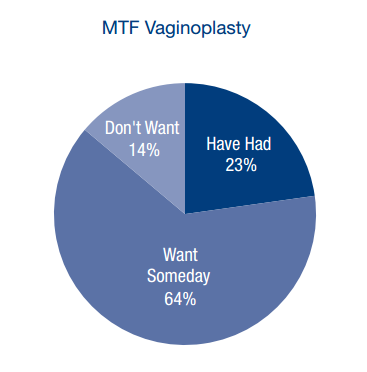
The point is that everyone's transition happens at different speeds, and everyone's transition ends up at a different point on this spectrum, and that the paths each person takes to get there are all as unique as they themselves. And if you can understand that, it becomes very easy to understand corollaries; that many trans women elect not to have vaginoplasty. That some come to terms with their penis, have reached a place in their own mind where it is not triggering for them, where it does not aggravate their dysphoria. That still others have the means, but feel the risk outweighs the reward. That most have no coverage, and lack the resources otherwise, to get the operation done in the first place, and so never even bother seriously debating the question anyway.

But whatever the reason, it's their decision because it's their gender. It's their choice of how to represent themselves in the ways that they suppose will win them the broadest correct interpretation of that gender. The physical changes are not so much for themselves personally and directly as they are for the broader culture that they live in to correctly interpret their gender, and to correctly understand their gender and engage with them appropriately for their gender in the context of their culture.

When I say that it's not specifically for themselves, I don't mean that it's not for them at all, because we internalize our culture. My ideas of what is feminine and what is beautiful are all determined by modern Western beauty standards, because that's what I've been surrounded by, that's what I've grown up with. I don't personally find body hair attractive. I've never found it attractive on anyone, of any gender. I'm going to great lengths to have most of my body hair permanently removed. I'm starting with my face, because that is one of the most common and visible culturally relevant gender markers.

A step I want to take beyond that, to have the leg hair permanently removed, for example, is a combination of my regard for bare, smooth legs as more feminine than not, and the fact that my skin tolerates all methods of hair removal very poorly. Shaving, depilatory creams, tweezing, sugaring, threading, and electrolysis. Waxing irritates my skin very badly, too. But only once a month. Only for a few days.

That's not just some arbitrary decision that I've made because I've just decided out of nowhere without any context that that expresses femininity. It's because my culture views that as a marker for femininity, and I've internalized that. So when I get it done permanently, and while I keep it up with waxing until then, I'm motivated by the culture that I've internalized, rather than truly by myself. It's so that when I look at myself, I see what I want our culture to see, so that it will understand me and interact with me in ways that are appropriate to my gender: as a more-feminine-than-not woman. Because that's who I am.

This past weekend, I went to my first Pride event, in Seattle. It was my first Pride event anywhere, my first Pride event of any kind. Kim (#girlfriend) was excited to take me, and I was excited to go with her. People kept asking me how many I'd been to, or if this was my first one, and I'd say, "this is my first one. When it was on last year, I didn't know any of it applied to me." Pride happens in June. I hadn't figured out that I was a girl until August. And while I had been supportive of LGBT concerns and problems, and fully on their side, I was also miserably depressed, and so the extent of my work as an ally was tabbing out of League every so often to Like a few pictures from the event.

A photo posted by Kim (@kiminoa_seattle) on

When I went this year, my first time, something that really struck me was how completely on-alert everyone was to look out for each other. Everyone. I saw someone drop his phone, and I and maybe 15 people on either side of me in each direction shouted, "PHONE!!!" Before it hit the ground, this guy turned, and looked, and saw it land. He picked it up, and said "thanks!"

I saw a little girl running by the fountain slip and fall and cut her elbow and bang her head pretty good, and stand up and start crying. This guy in shorts, just shorts, near the fountain ran up to her and made sure she was steady on her feet. He had her direct him to her adult, and he stayed with her the whole way, telling them what had happened before taking off back to where he'd come from.

Early on during the event, during the parade portion, Kim and I were not feeling especially well, so we ducked away from the main parade route, and found somewhere to sit down and have some water and a bite to eat. We got out our phones and started scrolling through Facebook. One of the things that I saw was a post from Jamie, who had added me as a Facebook Friend when I'd first contacted her. It was a picture of Cameron.

Jamie posts pictures of Cameron fairly often. As I imagine anyone would who had lost their child so young, so suddenly, in such a horrific way, for such an awful reason. I know I would. To remember who they were, to remember how they were. I saw her comments elsewhere, that it was coming up on two months to the day from the day he'd died. And I realized that he would never go to a parade like this.

And that devastating sense of loss that had connected me to Cameron, the same way it had connected me to Leelah Alcorn and Taylor Alesana, was brought into really sharp relief. Part of what was so crushingly sad about these girls' deaths to me personally was that I thought that something that might have really helped them would have been to see a trans woman like me. My age. To know that there's a life after high school for girls like us. To know that there are ways to survive for girls like us. And to know from firsthand experience that there are entire major cities that will love girls like us. And I started crying, right there on the spot.

My First Pride came very late in life, because I did not know who I was. Cameron's First Pride never came. Because he never had the chance to figure out who he was.